Four hours at the gathering place
The ferry docks at six and the bus leaves at 11:25. What to do with four hours in Devonport, all your luggage, and no sleep.
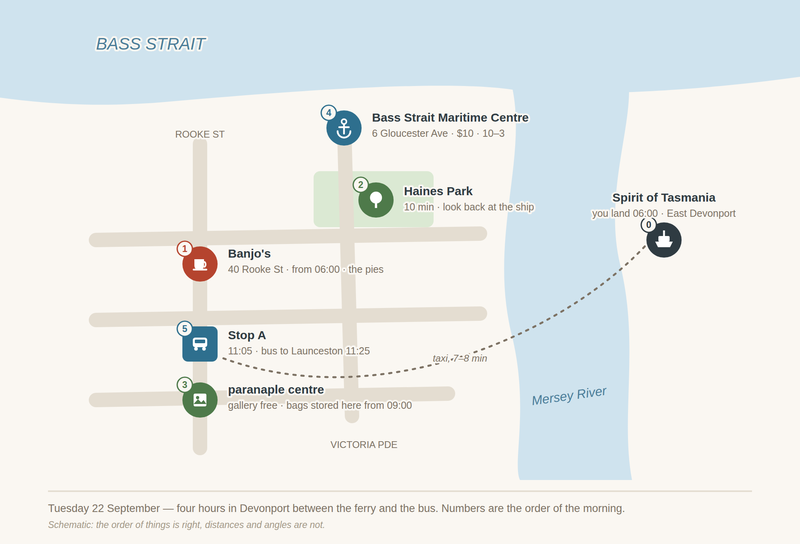
The ship reaches Devonport at six in the morning. The bus to Launceston leaves at 11:25. In between you have four hours, everything you own, and whatever sleep you managed in a reclining seat while a cold front crossed Bass Strait.
Most people drive off the ferry and are gone within the hour. Devonport is a place you pass through — which is precisely why it's worth stopping in.
The map
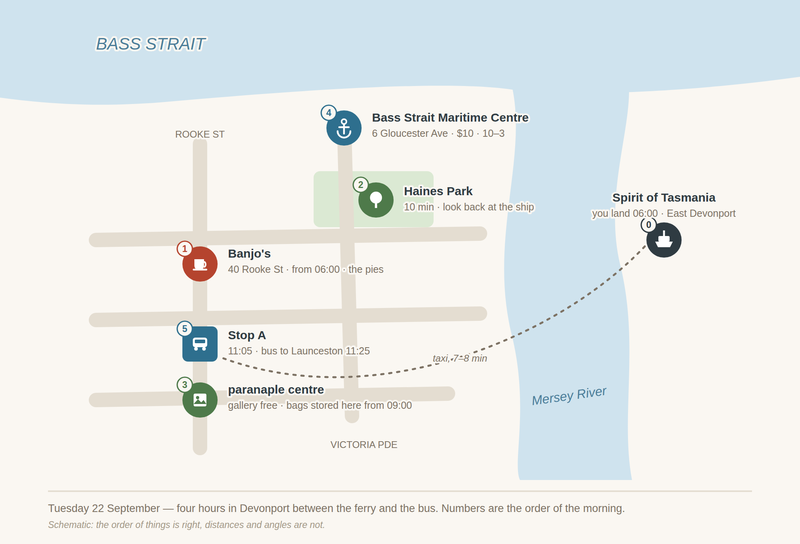
Four hours between the ferry and the bus. The terminal is in East Devonport, across the river from everything else — which is the first thing to know.
The name is older than the town
The civic building in the middle of Devonport is called the paranaple centre. Lowercase p, which is deliberate.
paranaple is a word from the punnilerpanner people, recorded in the nineteenth century as a name for the Mersey River — and glossed as gathering place, a meeting point at the mouth of a river. Other recorded names for the same water survive too: pirinapel, ponrabbel. It was written down by a Danish adventurer named Jørgen Jørgensen, which tells you something about how thin and second-hand the record is.
The council chose the name for the building, and the lowercase for the revived Tasmanian Aboriginal language palawa kani, which writes itself without capitals.
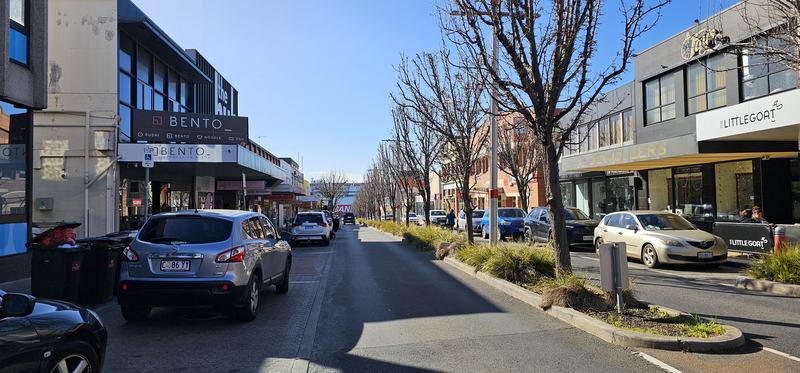
Rooke Street at nine in the morning: bare winter trees, a bento shop, a jeweller, and almost nobody about.
Sit with that for a moment. You have arrived at six in the morning at a river mouth, tired, looking for somewhere to gather before moving on. That is what this place has been for thousands of years, under an older name, for people who came by a different road. The building where you leave your luggage is called the gathering place, and it is not being poetic.
First, solve the luggage
Everything else depends on this. The Devonport Visitor Information Centre, in the paranaple building on Rooke Street, will hold your bags — but it opens at 09:00.
So the morning splits cleanly in two: two hours carrying everything, then two hours free. Plan accordingly, and don't try to do the good stuff first.
Breakfast, and the case for the scallop pie
Banjo's, 40 Rooke Street, opens at six — which is to say, it opens exactly when the ferry unloads. This is not a coincidence.
It's a Tasmanian bakery chain, and ordinarily a chain bakery is the thing a travel piece tells you to walk past. Not here. Order the scallop pie.
The Tasmanian scallop pie is a genuine regional dish, not a novelty: scallops in a curried cream sauce inside a pastry case, sold in bakeries across the state and almost nowhere else. It sounds wrong and it is completely right, particularly at seven in the morning when you have been awake since quarter past five. The Cape Grim beef is the other one people come back for.
My sister's verdict, delivered mid-pie: "quite nice — delicious scallop with curry seasoning." Which is the whole thing in seven words.
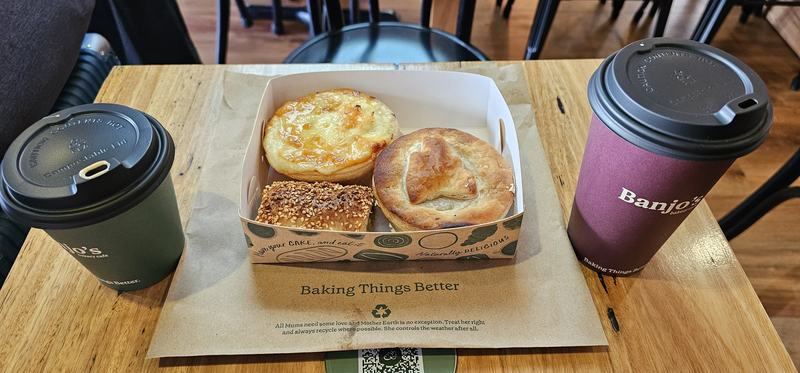
08:19. Scallop pie, cauliflower cheese pie, a sesame vegetarian roll, a latte and a chai latte — $37.60, and arguably breakfast.
Walk to the water and look back
Ten minutes from Rooke Street, Haines Park and the waterfront give you the Mersey, the working port, and — if the timing is right — the ship you just got off, sitting at the terminal on the far bank.
There is something specific about that view. You crossed 400-odd kilometres of open water overnight, mostly asleep, and here is the machine that did it, tied up and ordinary in the morning light. The strait you slept through is just there, past the river mouth.
It doesn't rest either. By evening it will be loading again for the run back to Geelong.
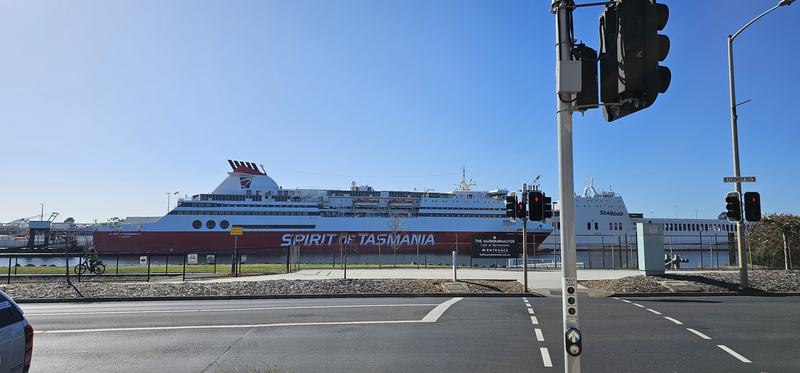
09:11, from Formby Road. Spirit of Tasmania I, tied up on the far bank — the ship we'd got off three hours earlier, already turning around for tonight's sailing back to Geelong.
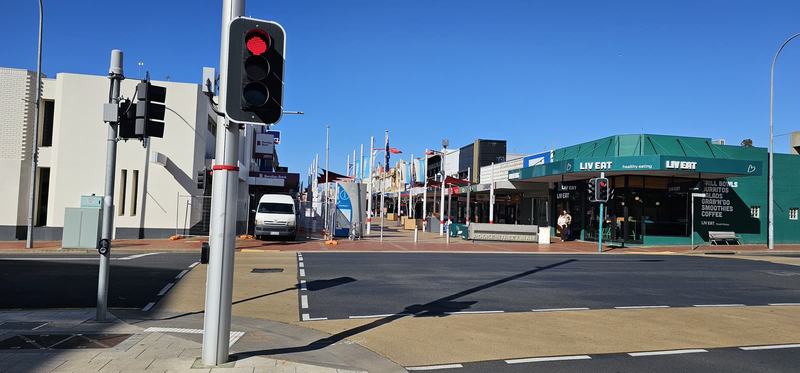
09:20. Back at the Formby Road lights, looking along the Rooke Street Mall.
The best thing in Devonport
Bass Strait Maritime Centre, 6 Gloucester Avenue. A 1920s harbourmaster's cottage on the river. $10 adult, open 10:00 to 15:00, seven days.
Go, and go hands-free once your bags are at the visitor centre.
Inside there's a ship simulator where you can try to navigate Bass Strait yourself — the crossing you completed a few hours earlier, minus the swell and the seasickness tablets. There are wrecks, ship models, and the ordinary business of a port town that has been loading and unloading for a century and a half.
And there is a room that is worth the whole stop. **Uncle Rex Greeno's paperbark ningher — a traditionally made canoe — and Aunty Lola Greeno's shell necklaces**, with storytelling about Tasmanian Aboriginal people's relationship with this sea.
The timing of that is hard to shake. You have just crossed Bass Strait in eleven hours on a ship with a cafeteria and paid wi-fi. Twelve thousand years ago it wasn't a strait at all but a plain with lakes in it, and people walked it. When the sea rose and closed the crossing, the people on the Tasmanian side were cut off from every other human being on earth for four hundred generations. The canoes in that room belong to that story.
You will have about forty minutes. It's enough, and it's the right forty minutes.
What four hours doesn't buy
Two things worth knowing about, and worth coming back for.
Home Hill, on Middle Road, was the family home of Joseph Lyons — Premier of Tasmania, then Prime Minister of Australia from 1932 until he died in office in 1939, still the only person to have held both offices — and of Dame Enid Lyons, who in 1943 became the first woman elected to the House of Representatives and in 1949 the first woman in federal cabinet. They raised eleven surviving children in that house. She lived there until 1981. It's a National Trust property and it is not a five-minute stop.
tiagarra, at Mersey Bluff, is a Tommeginne word meaning keep, or keeping place. The headland holds Aboriginal rock carvings — among the best preserved in Tasmania, noticed by a local schoolteacher in 1929 and protected soon after. Too far with luggage and a bus to catch, which is a poor reason to miss it.
The practical bit
- The terminal is in East Devonport, across the river from the town. It's about 5 km by road. Take a taxi — the nearest local bus stop is a 13-minute walk from the terminal, which is not what you want at 6am with bags.
- Buses are free. Tasmania has scrapped fares on public transport — local and intercity — until 30 June 2027. Don't tap a card, just get on. The local 175 into town is free, and so is the coach to Launceston.
- Bags at the Visitor Information Centre, paranaple building, from 09:00. Ring 1800 649 514 first.
- Devonport Regional Gallery is free, in the same building, open from 09:00.
- Stop C is not Stop A. The local bus arrives at C; the intercity coach to Launceston leaves from A. Same interchange, a few metres apart, and very easy to get wrong when you're tired.
Four hours is not enough for Devonport. It is, however, exactly enough to stop treating it as a car park with a boat attached.