A gorge at the end of the street
Off the coach at one o'clock, and by half past two you can be standing in a 140-million-year-old gorge. An afternoon plan for Launceston, in the order that saves you two kilometres of walking.
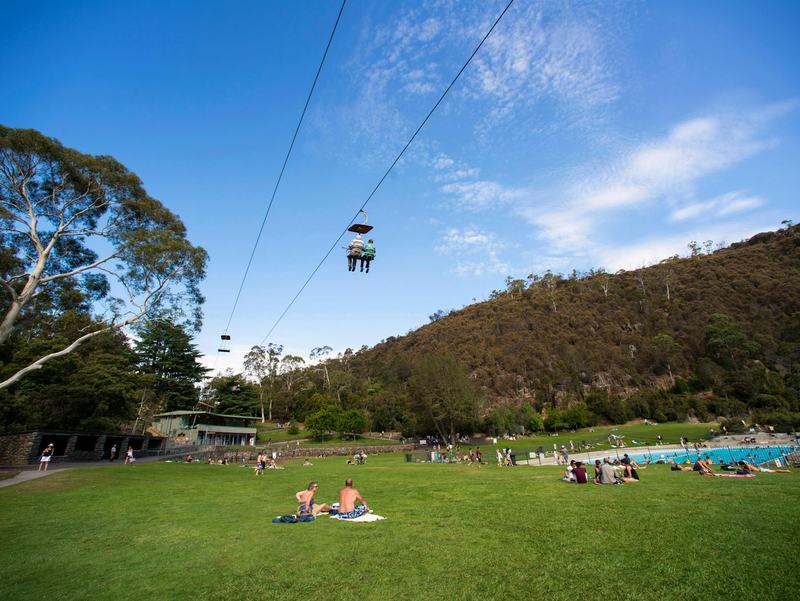
The coach from Devonport gets into Launceston at about one o'clock. By half past two you can be standing on a suspension bridge over a river gorge that is older than the flowering plants.
You don't have to go anywhere to do it. That's the thing about this city.
The map
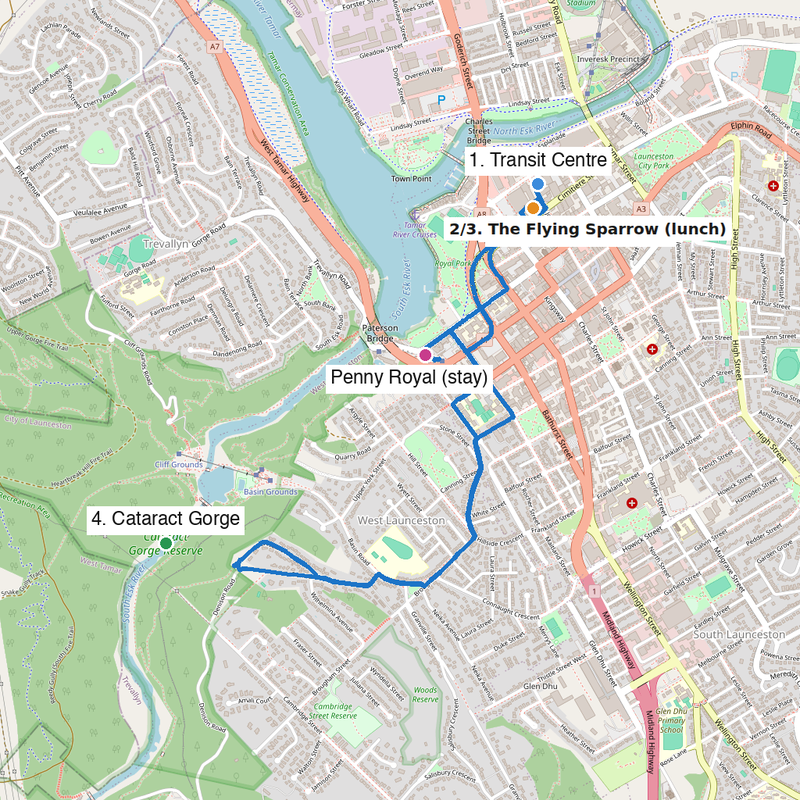
Transit Centre to lunch to the hotel to the Gorge. Map data: OpenStreetMap contributors, route via OSRM.
1. Eat before you check in
This sounds like fussing. It is worth two kilometres.
The coach drops you at the Launceston Transit Centre, 25 St John Street. Penny Royal, where you're sleeping, is a twelve-to-fifteen-minute walk out at the other end of town. So eat while you're still in the middle, then walk to the hotel once. Check in first and you'll walk out, walk back for lunch, and walk out again, with your luggage, for no reason at all.
We ate at The Flying Sparrow, on the Brisbane Street corner opposite Launceston College, at the lights where the signs point to Seaport and QVMAG.
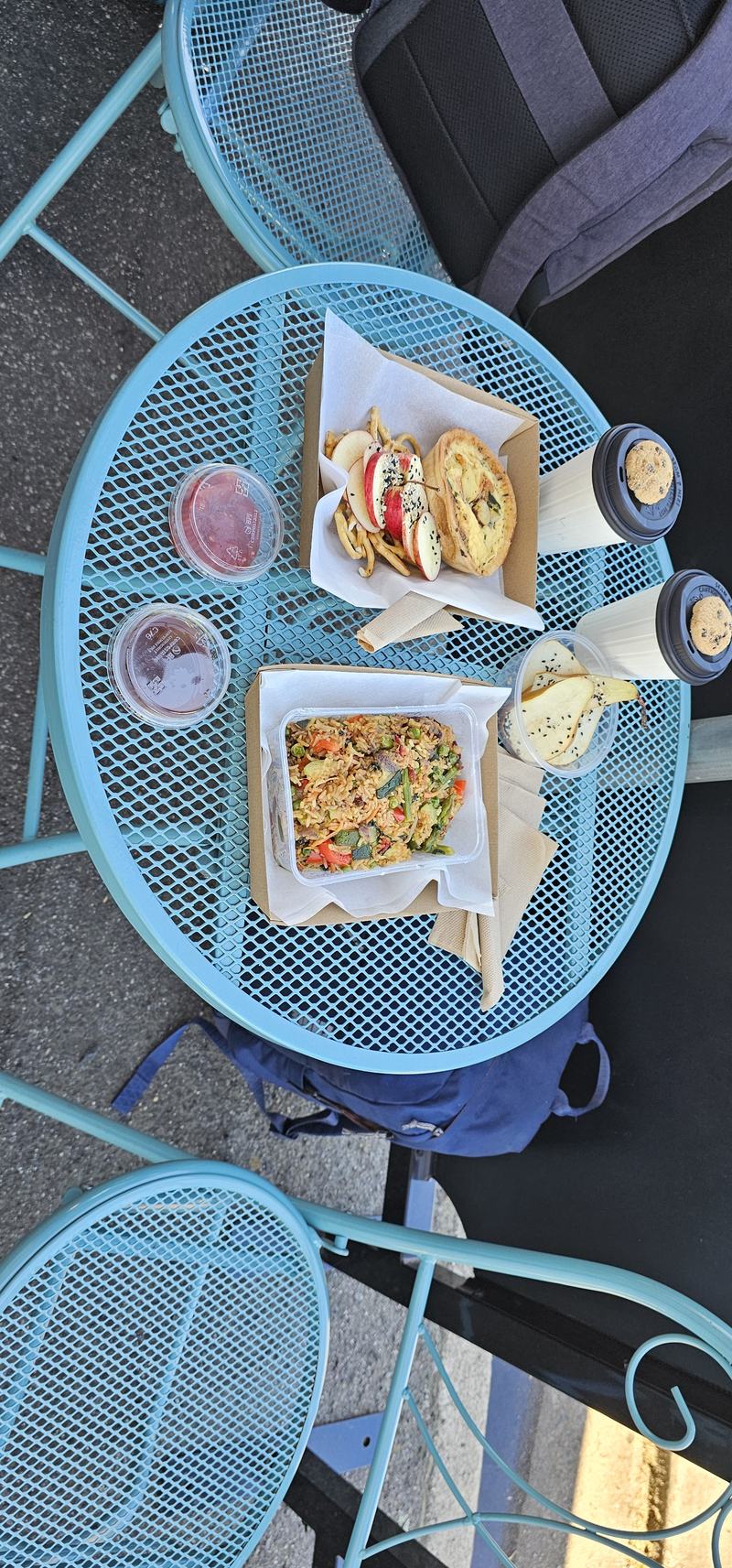
Vegetable fried rice, a noodle salad with a vegetable tart, fruit pots, a chai and a coffee.
$50.95 for two, and my sister's verdict was the right one: "the food is excellent and delicious, and the presentation is very neat and gracious."
That last word is the one worth sitting with. This is takeaway packaging, on a footpath, at a set of traffic lights, with three suitcases parked beside the table — and it still arrived looking considered. Apple slices fanned under black sesame. A cookie balanced on each cup lid. Nobody had to do that.
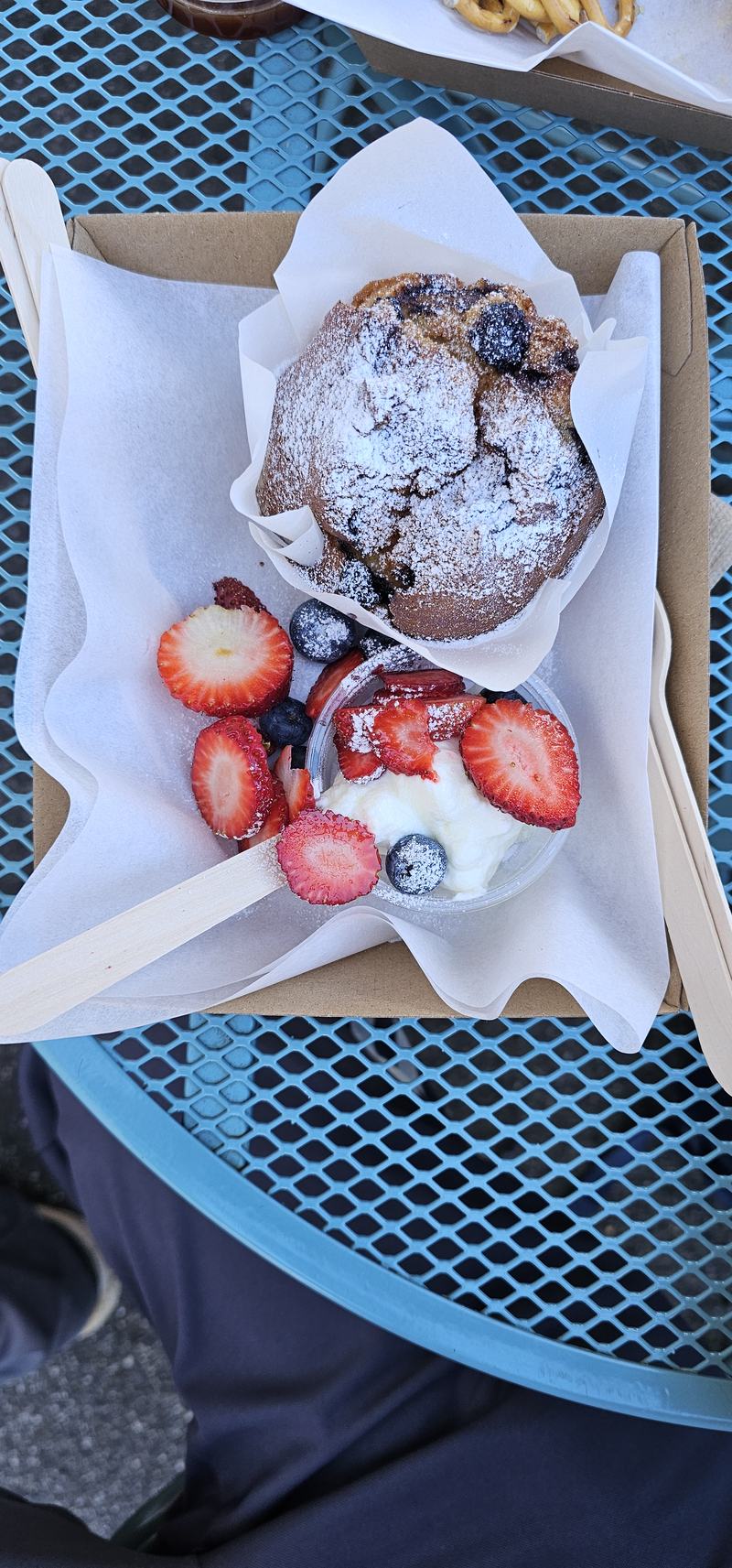
The organic yoghurt and the muffin — not too sweet, good texture.
The coffee is strong, not weakened by the milk, which in a tourist town is not a given. The chai was excellent. The one caveat: order less than we did. It defeated us, and the cookies went in a bag for later.
The seating is a footpath parklet — pale blue tables in a planter-boxed bay off the traffic, umbrella'd, sunny at lunchtime in September. It is a street-corner lunch rather than a quiet one. The trade is that you can keep three suitcases where you can see them and still eat properly.
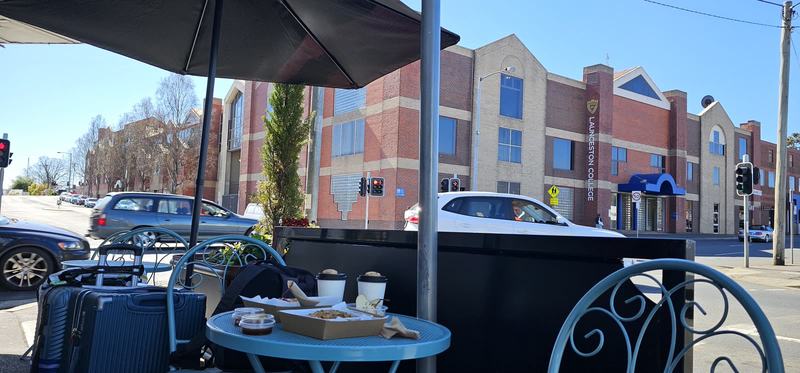
13:46. The corner table, the suitcases beside it, Launceston College across the road.
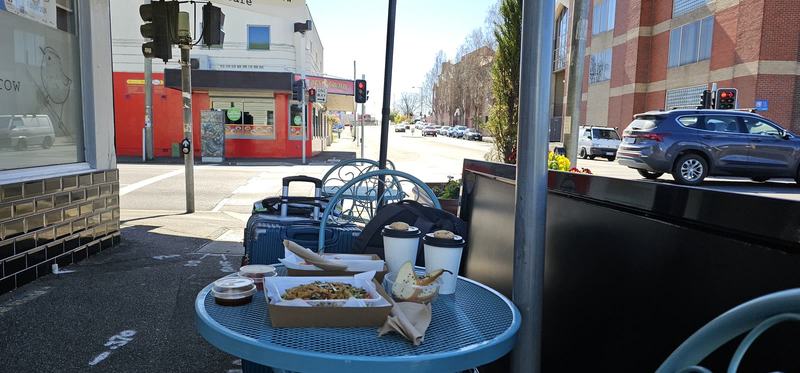
And the other way, down the street.
Worth knowing what you've walked into: Launceston is a UNESCO City of Gastronomy, and was Australian Town of the Year in 2022. Which makes a neat pairing with where you were yesterday — Geelong is a UNESCO City of Design. Two provincial cities that decided, separately, to be known for something.
2. Australia's third-oldest city
Launceston was founded in 1806 by Lieutenant-Colonel William Paterson — after Sydney and Hobart, and before Melbourne by thirty years. For a short while it was called Patersonia, until Paterson renamed it after the Cornish town where Governor Philip Gidley King was born. A man naming a colonial outpost after his boss's birthplace is about as nineteenth century as it gets.
It sits where the North Esk and South Esk rivers meet and become the Tamar — a tidal estuary that winds sixty-five kilometres north to Bass Strait. Which is to say: to the water you crossed last night. Everything on this trip keeps leading back to that strait.
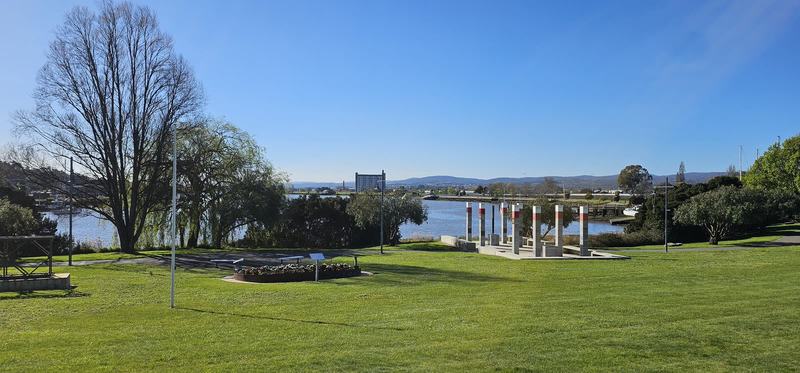
15:20. Royal Park: a lawn, a colonnade and the river.
3. The Gorge starts at the hotel door
Leisure Inn Penny Royal, 147 Paterson Street, sits at the entrance to Cataract Gorge. You check in, drop the bags, and walk out into it.
The South Esk cuts through dolerite here, and the rock is estimated at over 140 million years old. The first European to find the entrance was William Collins, in 1804 — two years before there was a town. The path you'll walk along the northern bank, the King's Bridge–Cataract Walk, was built by volunteers in the 1890s.
That's the part I like. Not a government project, not a tourist scheme — townspeople who decided their city should be able to walk into its own gorge, and went and built the path.
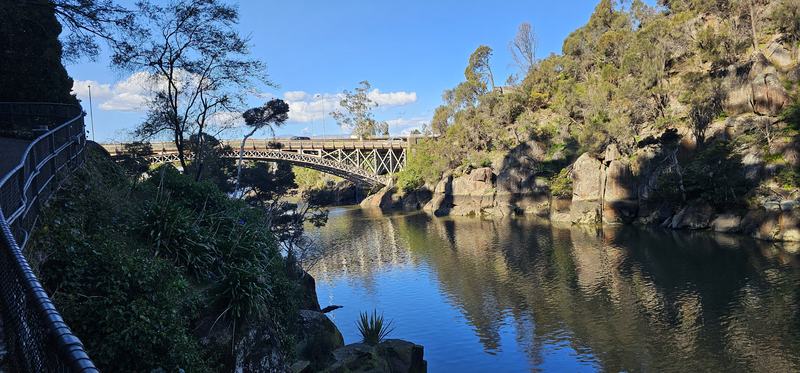
Kings Bridge, from the volunteers' path. The city is directly behind it — that's how close this is.
That is the thing the photographs never quite carry. There is a main road on the other side of that arch. You walk under it, round one corner, and the traffic stops existing.
The hotel is not from here
Walk out of reception and there is a windmill above the car park. Full sails, a balcony, whitewashed tower. In Launceston.
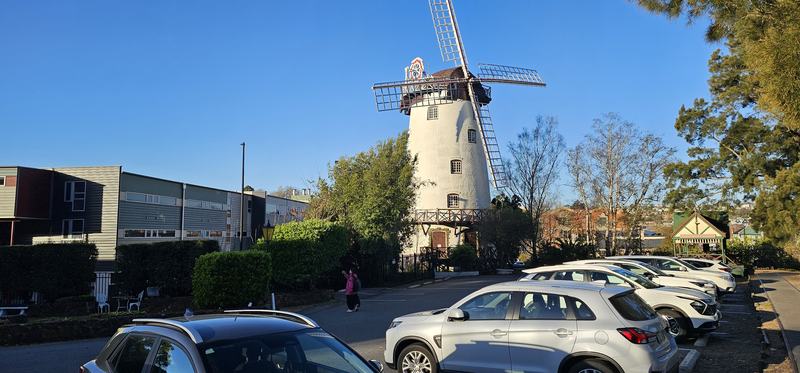
The windmill, from the car park. Not a folly exactly — but not native to this spot either.
Here's the thing. Almost none of this complex started here.
The story goes that in 1972 a local developer, Roger Smith, found convict-made bricks at Barton in the midlands — from buildings put up by the Gatenby family, who arrived in 1823 and farmed between Cressy and Ross on a waterway then called Penny Royal Creek (today the Isis River). They had built a substantial mill there with convict labour, and it served the district for about fifty years.
Those buildings were taken apart and rebuilt here, inside a disused rock quarry in the middle of Launceston. The attraction opened in 1979 with a boat ride, firing cannons, radio-controlled boats and a barge explaining how to make gunpowder. At its peak in 1980–81 it took 4,666 visitors in a single day.
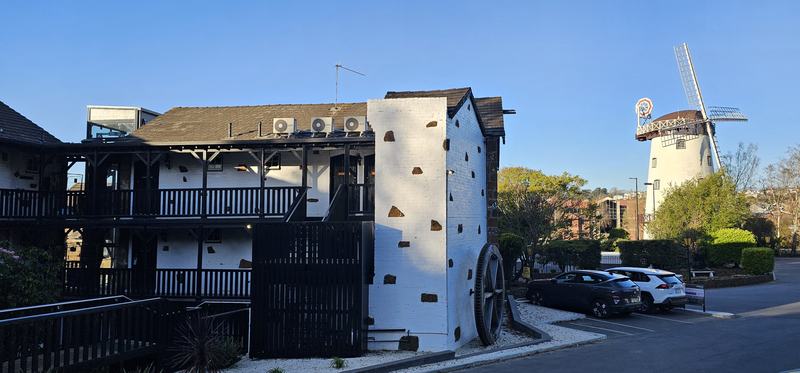
The mill machinery is still lying about the place, outside the rooms.
So the "1840s corn mill" you sleep in is genuinely an 1840s corn mill — just not one that was ever on this site. It was carried a hundred-odd kilometres north and reassembled next to a gorge, as a tourist attraction, in the decade of the chairlift.
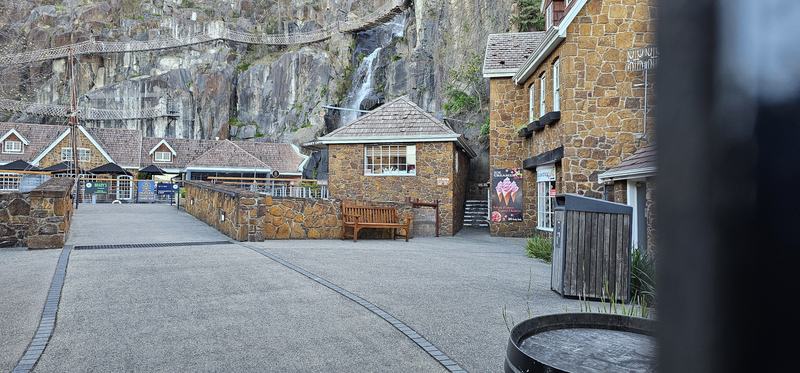
The quarry face, with a waterfall and rope bridges. The ice creamery is on the right.
And the quarry didn't go anywhere. It's still the back wall — with a waterfall down it and rope bridges strung across it, because the site is now an adventure park as well as a hotel. You can be eating an ice cream while somebody inches across a net forty feet above your head.
It is, frankly, a strange place to stay. It's also a hundred metres from a 140-million-year-old gorge, and the strangeness is free.
(That history comes from the operator's own account and secondary summaries rather than an archive, so treat the details as the house version.)
4. The bridge that washed away
The Alexandra Suspension Bridge was built in 1904 and named for Queen Alexandra, consort to Edward VII.
In 1929 the Great Flood tore it out entirely. They rebuilt it a few years later, and it's the bridge you'll cross.
Stand on it and look up the gorge. In 1929 that quiet green water came through high enough to take a suspension bridge with it.
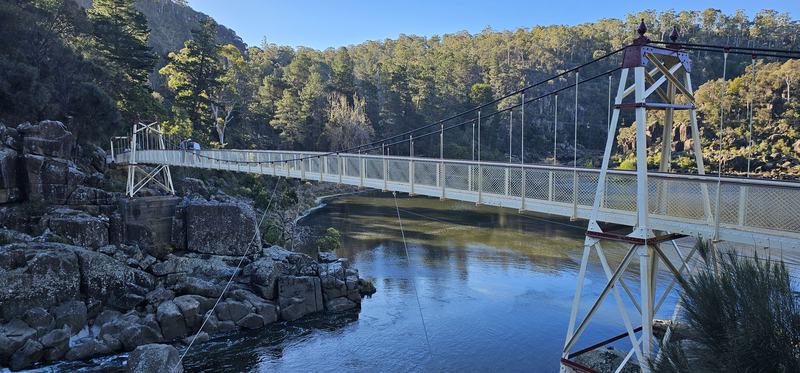
The 1904 bridge, rebuilt after 1929. Cream lattice, dark red trim, and a deck that moves when people walk on it.
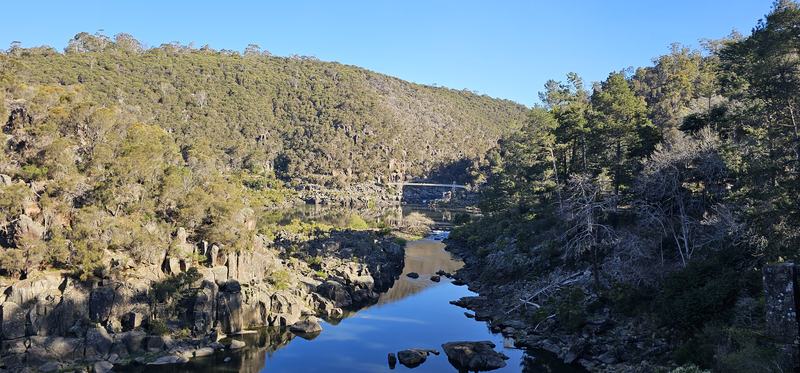
The same bridge from further along, for scale. Everything in this photograph is inside the city limits.
5. The world record above your head
The Gorge Scenic Chairlift was built in 1972 and crosses First Basin.
It holds a world record: the longest single span of any chairlift anywhere — 308 metres, with a total length of 457 metres. Not the longest chairlift; the longest unsupported gap between towers. There is no pylon in the middle of that basin, which is why the span is what it is.
Ten minutes, and one of very few places on earth you can ride a chairlift across a gorge. Take it if the weather is kind and you've the energy. Skip it without guilt if you haven't — the walk is the main event.
The practical bit nobody tells you: it has two stations, and every listing gives you the wrong one.
The ticket office and drive station are at 69 Basin Road, West Launceston — southern side, by the First Basin car park. That is the address for people arriving by car. But walking in from Penny Royal you are on the northern bank, and the second station sits in the middle of the Cliff Grounds. That is the one you reach first. Board there and you needn't walk round to Basin Road at all.
Listings say daily from 9am, 365 days a year, closing around 5pm in spring, about $16 one way / $21 return. Ring (03) 6331 5915 before you set out if it's after about half past three — it's a twenty to thirty minute walk each way, and the last ride goes before closing.
And what it's actually like: you are sitting on a chair.
Not a cabin, not a gondola, not a pod with a door. A chair, in the open air, with nothing underneath you but the gorge. You feel the air move. You watch the water and the rocks go by below your feet. People pass overhead in the other direction and you look straight at each other, close enough to nod.
It's exciting, and I'd do it again. But be honest with whoever you're travelling with before you buy two tickets: my sister was trembling the whole way across. Same chair, same view, entirely different ten minutes. If heights are a problem, this is not the gentle scenic option the word "chairlift" suggests — the whole point of that 308-metre span is that there's nothing in the middle.
6. Look for the peacocks
The Cliff Grounds, on the northern side, are Victorian gardens — ferns, lawns, a rotunda — and peacocks wander them freely. Don't feed them. Do look for them.
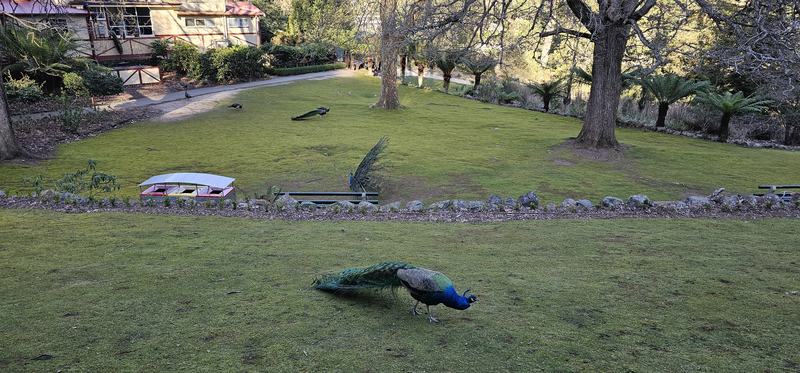
Not a promise — an observation. There were several, unbothered, mid-afternoon.
They really are just there, on the grass, at a walking pace, entirely uninterested in you.
Afternoon light falls on the bridge and First Basin side, which is also the side you're walking from. No detour required for the photograph.
Two hours at a stroll covers the lot. The paths near Penny Royal are sealed and mostly flat, so ordinary shoes are fine unless you head up the cliff tracks.
The empty pool, and the duck
Two things I didn't expect.
There is a swimming pool in the gorge, at First Basin, and it was closed and drained. I already found it odd that a public pool exists inside a river gorge, a few metres from an actual river. Empty, it is odder still — a tiled rectangle of nothing, surrounded by water.
(It's seasonal. It opens for summer. We were a few weeks early.)
And then: a duck, swimming upstream, that got stuck in the middle.
It went at the current, made some ground, and then simply stopped — holding position, paddling, going nowhere, in the middle of the South Esk. We watched for a while. We walked on.
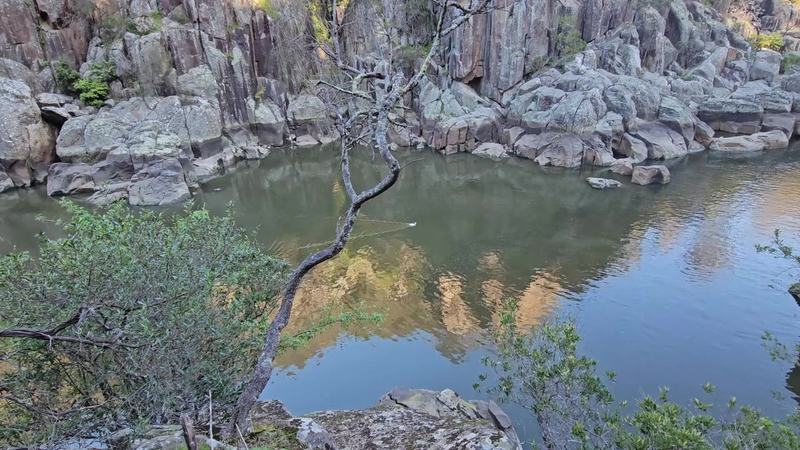
15:34. Four seconds of the South Esk: a white duck on the water, its wake trailing behind.
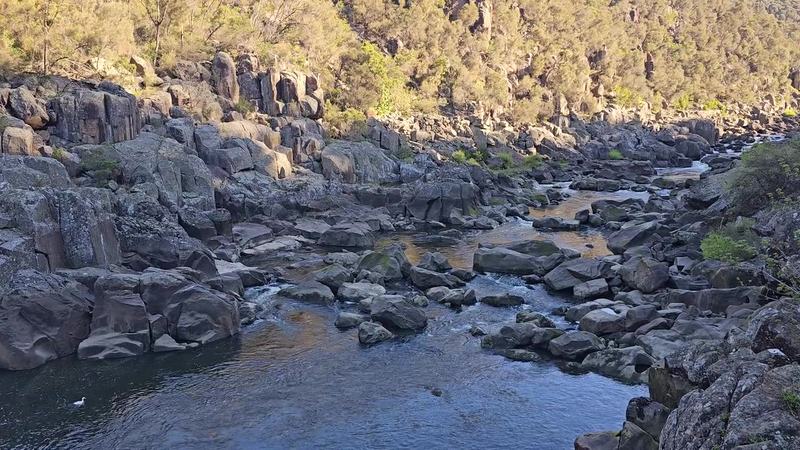
15:35. A minute later: a white duck holding its place against the current, going nowhere.
I still want to know what happened to that duck, and I never will. Which is, I think, the correct number of things to not know about an afternoon.
What my sister actually saw
She kept saying it reminded her of the Sakadang Trail, in Taroko Gorge in Hualien, Taiwan. Riverside path, cliffs on both sides, water the colour of jade.
Here is the part that took me a moment to catch up to.
On 3 April 2024, a magnitude 7.2 earthquake struck off Hualien — Taiwan's worst in twenty-five years. It brought the mountains down into the gorge. Parts of Taroko have since reopened, but the Sakadang Trail has not, and neither have the Tunnel of Nine Turns or Swallow's Grotto. There is still no reopening date.
So she wasn't only saying this is like a place I love. She was saying this is like a place I currently cannot walk.
That reframed the whole afternoon for me. We came to Launceston for a gorge at the end of the street, which is a good enough reason. What she got was a version of somewhere she's been waiting two and a half years to go back to — the sound of it, the cold air off the water, the path cut along the cliff — standing in for the original until the original comes back.
Gorges are not interchangeable. But on a clear Tuesday, one will hold the place of another for a couple of hours.
7. Dinner without going anywhere
Kings Bridge Bar & Restaurant, 147 Paterson Street — the same building as Penny Royal. After a night on a ship and a day on a bus, the great virtue of this is that it requires nothing of you.
(Brady's Tavern, also at Penny Royal, shuts Monday to Thursday in school term, so it's out on a Tuesday.)
If the afternoon runs short
Both free, both easy, both entirely skippable:
- City Park's macaque enclosure — ten Japanese macaques, given to Launceston in 1979 by its sister city Ikeda. Open 8am–4pm. A genuinely strange ten minutes.
- Queen Victoria Museum & Art Gallery, Royal Park, 10am–4pm, free.
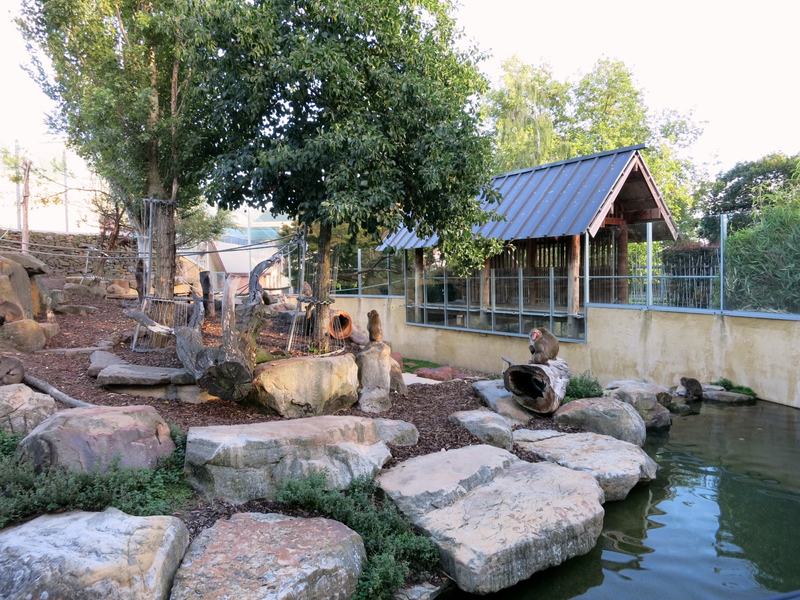
City Park's macaques, a gift from Ikeda. Photo: Nick-D, Wikimedia Commons, CC BY-SA 4.0.

The short version
- 13:00 — Off the coach at the Transit Centre
- 13:15 — Lunch at The Flying Sparrow — before the hotel, not after
- 14:00 — Walk to Penny Royal, check in or leave the bags
- 14:30 — Into the Gorge: the volunteers' path, the 1904 bridge, First Basin, the peacocks
- Chairlift if you feel like it. Two hours at a stroll
- evening — Kings Bridge, same building
And if you're flat — you crossed Bass Strait last night in a chair — do the lower Gorge and the first lookouts, skip the chairlift, and eat early. Reception is open until eight. The gorge has been there 140 million years; it will hold for a morning.