Cut into the cliff
Twice, Hobart has cut into a cliff to build what paid its way. In the 1830s convicts quarried sandstone for whale-oil warehouses. In 2011 a gambler dug a museum into the rock. A Saturday at both, joined by the river.
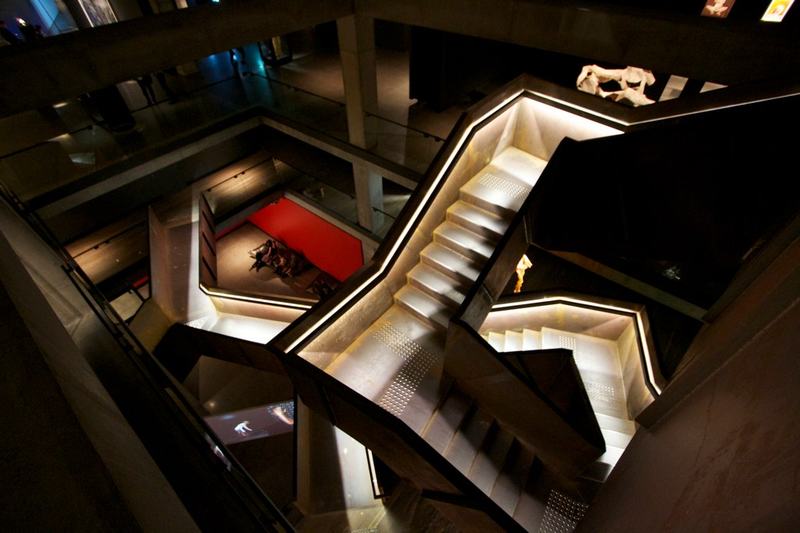
Twice, Hobart has cut into a cliff to build the thing that paid its way.
The first time was in the 1830s. Convicts quarried the cliff below Battery Point to make a new wharf, and used the stone for warehouses to hold whale oil. The second time was in 2011, when a man who had made his fortune betting dug a museum into the rock at Berriedale.
Today we visit both: the warehouses in the morning, the museum in the afternoon, and the river in between.
The map
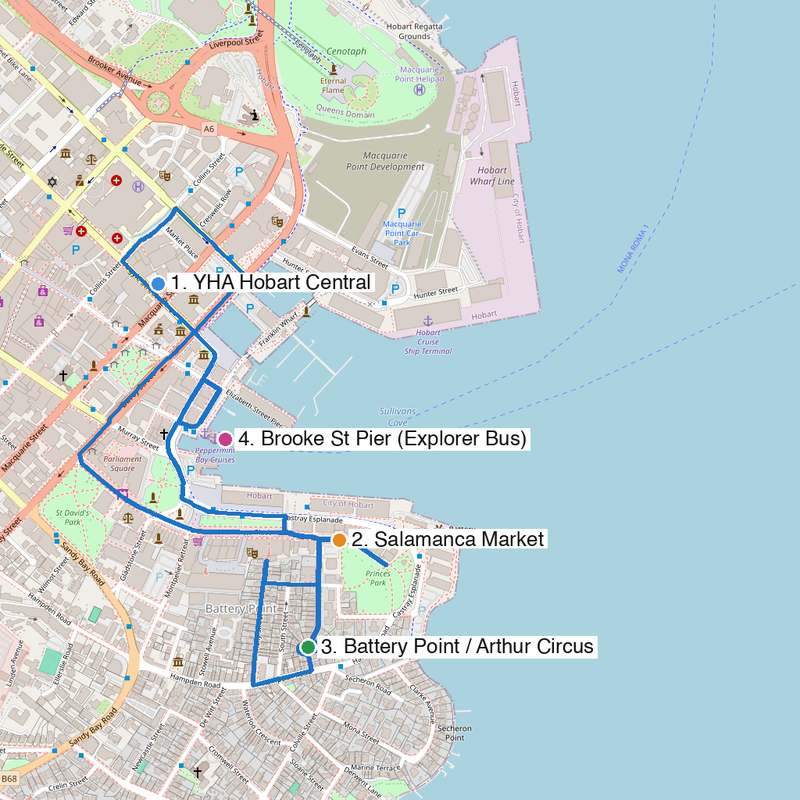
The morning on foot, ending at the ferry. Map data: OpenStreetMap contributors, route via OSRM.
1. A market in the warehouses
On Saturdays, Salamanca Place fills with stalls. The first market was held on 6 November 1971: six stalls, run by the National Council of Women. It was officially launched on 22 January 1972, with twelve stalls beside the silos. Now there are more than 350, every Saturday from 8:30 to 3:00, run by the City of Hobart.
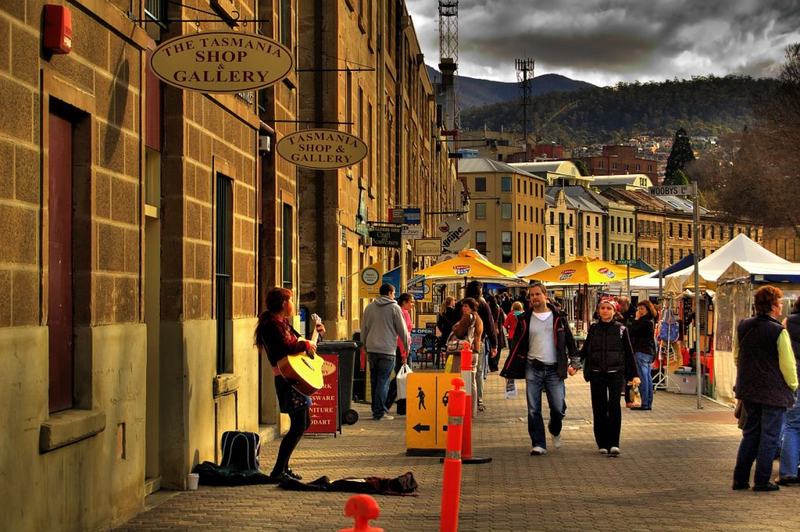
Salamanca Place on market morning. Photo: Jes, Wikimedia Commons, CC BY-SA 2.0.

Behind the stalls are the reason the place exists: a long row of Georgian sandstone warehouses, now galleries, cafés and shops.
2. What the warehouses held
In the 1830s the old wharf, now Hunter Street, couldn't cope. Hobart was a whaling port, and it was booming. The most valuable cargo coming off the ships was whale oil, baleen and bone.
So convicts were set to quarry the cliff face below Battery Point for a new wharf. They cut the sandstone out, and built the warehouses from it. Walk behind the row and you can still see where the rock was taken.
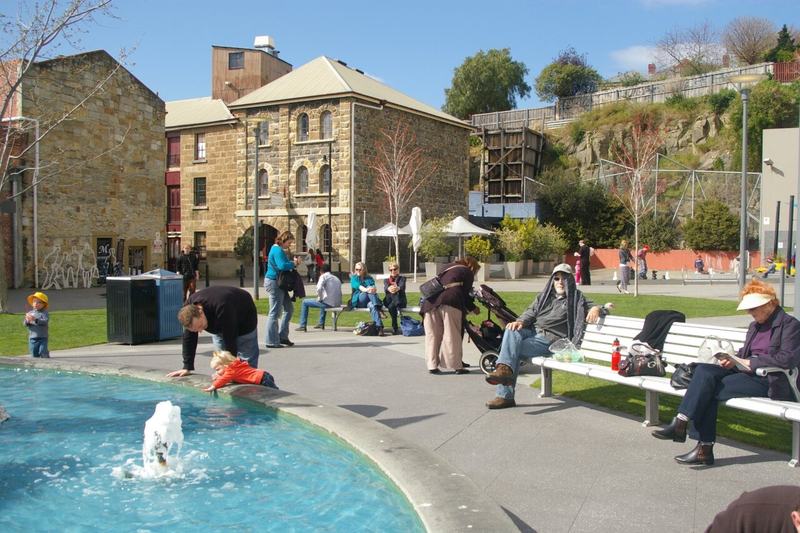
The old quarry face behind Salamanca Place. Photo: Owen Allen, Wikimedia Commons_Salamanca_quarry_2012.jpg), CC BY 2.0.
Yesterday, at Wineglass Bay, we read about the whalers who turned a bay red. This is where their oil came to be stored and sold.
The place was called the Cottage Green before it was Salamanca. It was renamed after the Duke of Wellington's victory at the Battle of Salamanca in Spain, in 1812. Remember the Duke. He comes back on Monday.
3. The whaler's steps
At the end of the row, a narrow flight of stone steps climbs the cliff to Battery Point. They are Kelly's Steps, cut into the rock in 1839–40 by James Kelly.
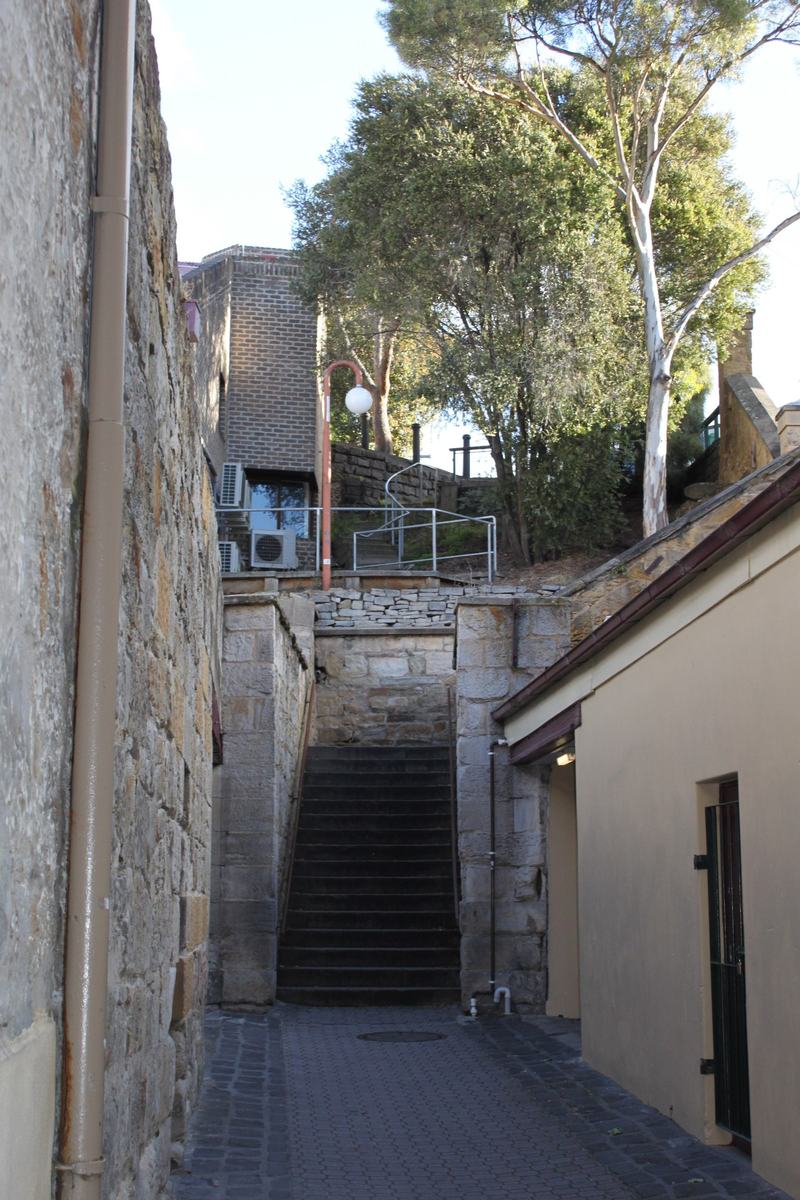
Kelly's Steps. Photo: Travis, Wikimedia Commons, CC BY 2.0.

Kelly was born in Parramatta in 1791, probably the son of a convict woman transported from Dublin. In 1815–16 he took a whaleboat all the way round Van Diemen's Land, and found Port Davey and Macquarie Harbour on the way. He became the harbourmaster at the Derwent. Between 1824 and 1841, his ships made 24 whaling voyages. On that trip round the island, he was most likely the same Captain Kelly who noted a party of Aboriginal people on Schouten Island, off Freycinet, in 1816.
It didn't last. The depression of the 1840s ruined him, and he died in Hobart in 1859.
At the top of the steps is Battery Point, named after the battery of guns put there in 1818 to defend the harbour. At its heart is Arthur Circus, a round green ringed with cottages built for the garrison's officers.
4. The gambler's cliff
Eleven kilometres up the river, at Berriedale, is the second cliff.
David Walsh grew up in Glenorchy, in Hobart's northern suburbs. He made his fortune developing a gambling system for betting on horse racing and other sports. With it, he built MONA, the Museum of Old and New Art. It opened on 21 January 2011, on the grounds of the Moorilla winery, which an Italian-Australian textile merchant, Claudio Alcorso, had started in 1958.
Rebuilding it as MONA cost about $75 million, and most of it is underground, built into the cliffs so the old buildings above could stay. Walsh has called it a "subversive adult Disneyland". Inside, a staircase takes you down into three levels with no windows.
Down into MONA. Photo: Rob Taylor, Wikimedia Commons, CC BY 2.0.

Two works to find: Cloaca Professional by Wim Delvoye, a machine that copies the human digestive system, and bit.fall by Julius Popp. Some of the art is confronting. MONA says so itself.
It worked. In 2013 Lonely Planet put Hobart in its top ten cities to visit, with MONA as a reason, and in 2018 the museum had 347,000 visitors.
5. Up, then down
The best way in is the one Walsh designed: by water. The MONA ferry takes about thirty minutes from Brooke Street Pier. The seats include sheep and tigers.
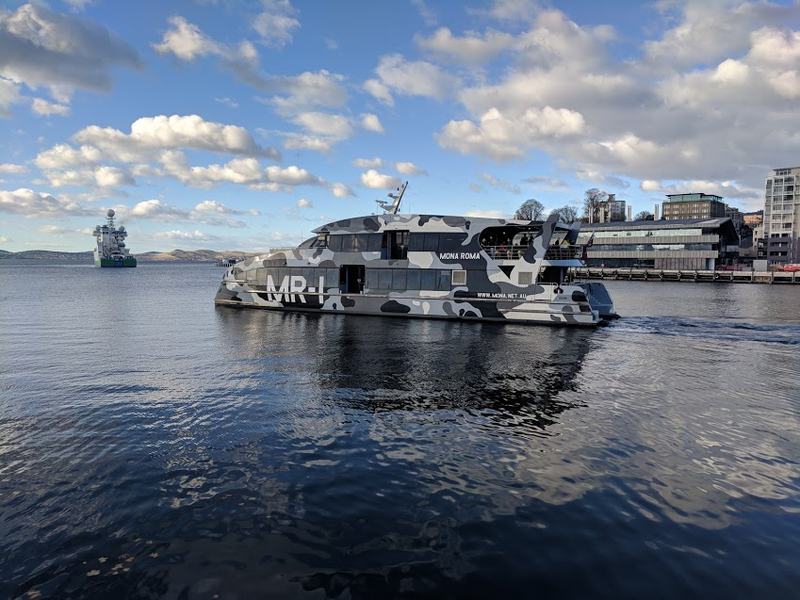
The MONA ferry. Photo: Timox14, Wikimedia Commons, CC BY-SA 4.0.

At the other end there are 99 steps up from the jetty. There's a tunnel for anyone who needs it. But in MONA's own words: "even though there's a shortcut, Mona requires you to climb the 99 steps to then descend again."
So you climb the cliff, then go down inside it.
Inside, the rock is everywhere. Tunnels ringed in steel run through the sandstone between the galleries.
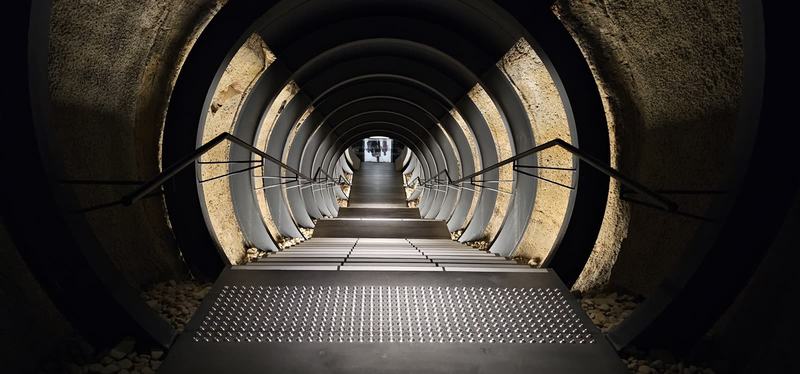
A tunnel through the sandstone at MONA.
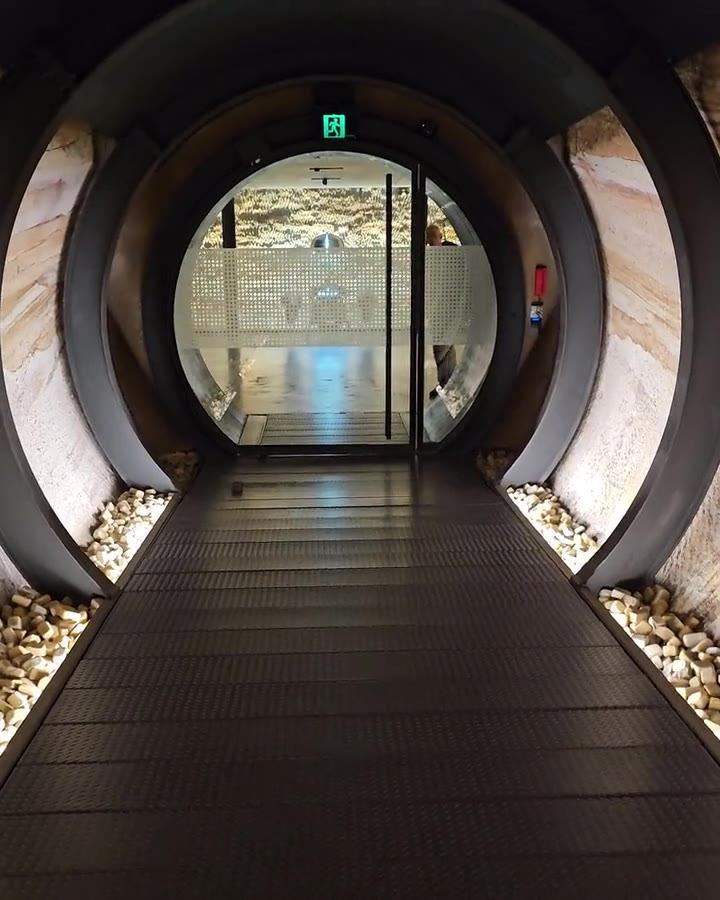
Walking towards the door at the end of the tunnel. (4-second video.)
In one of them, Siloam, which opened in 2019, stands Ai Weiwei's White House (2015): the timber bones of a Qing-dynasty house, painted white, standing on glass balls.
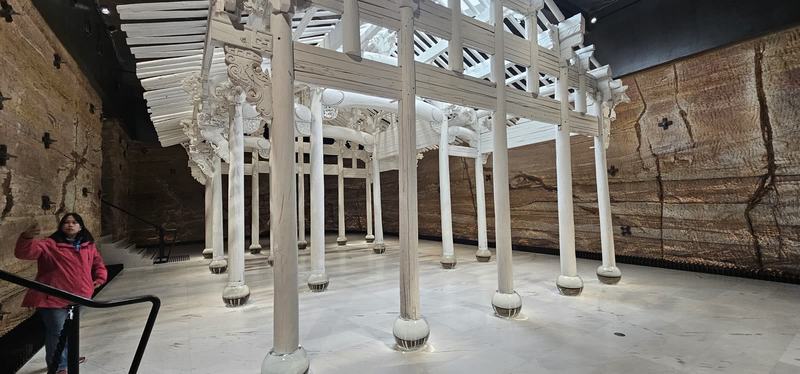
Ai Weiwei, White House, 2015.
Wilfredo Prieto's White Library (2004) is about 6,000 books with nothing in them. There are tables and chairs, so you can sit down and read nothing.
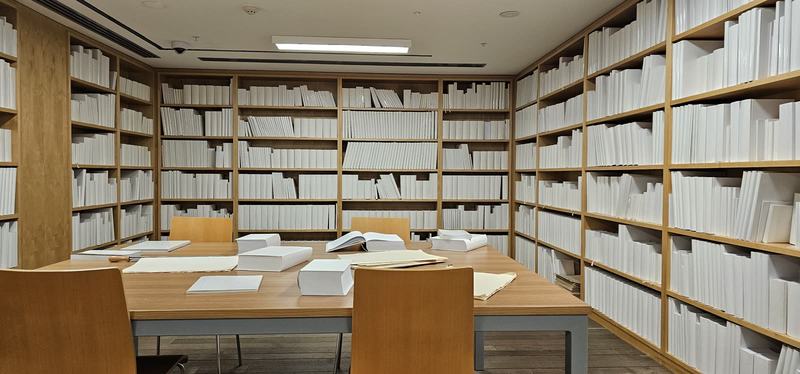
Wilfredo Prieto, White Library, 2004.
Erwin Wurm's Fat Car is a real Porsche, swollen with styrofoam and fibreglass until it looks like a body.
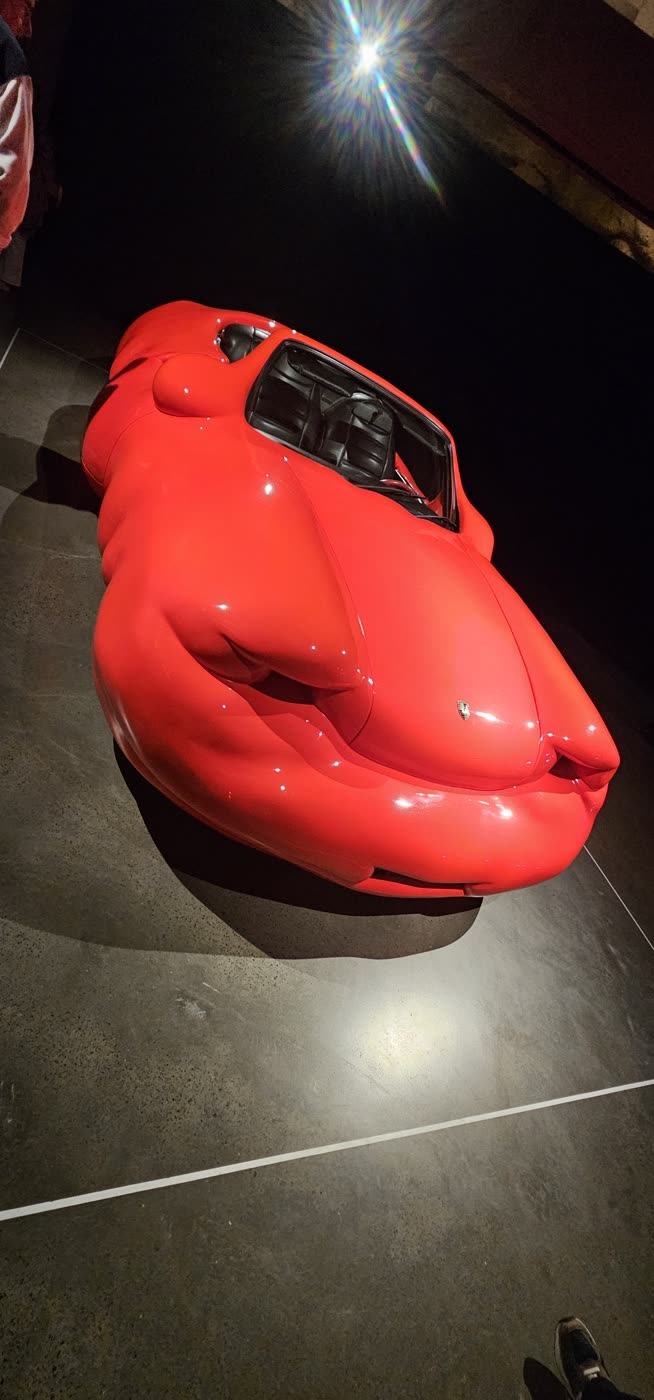
Erwin Wurm, Fat Car.
Gregory Barsamian's Artifact (2010), which Walsh commissioned, is a steel head three metres long, lying on its cheek. Look through the holes in its side: inside, a spinning, strobe-lit zoetrope shows apples falling into green hands, and birds crushed by books slamming shut.
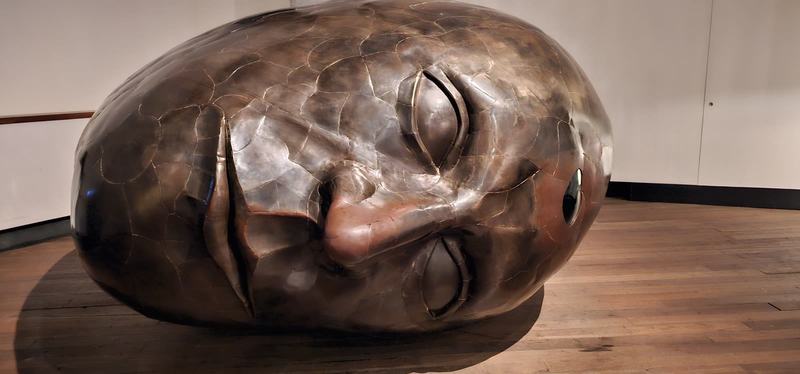
Gregory Barsamian, Artifact, 2010.
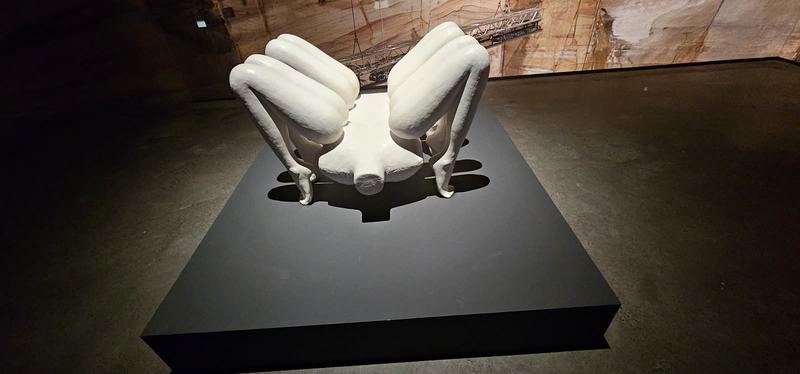
A white figure in the dark. We couldn't find who made it.
Lunch was pizza at the Void Bar, rocket and parmesan, then out onto the lawn, where the sun came through between the showers and kunanyi sat behind the trees.
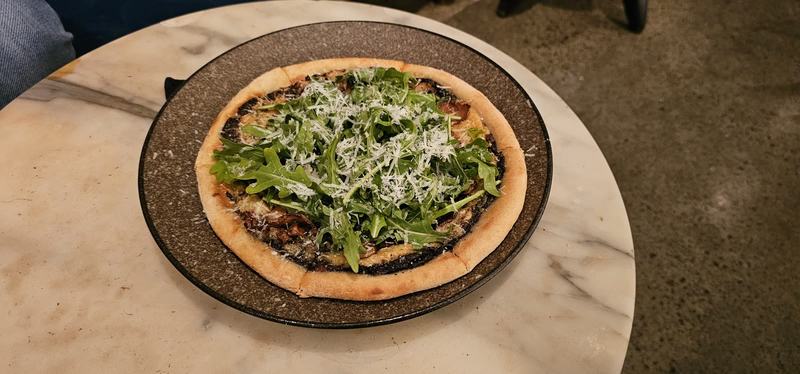
Lunch at the Void Bar.
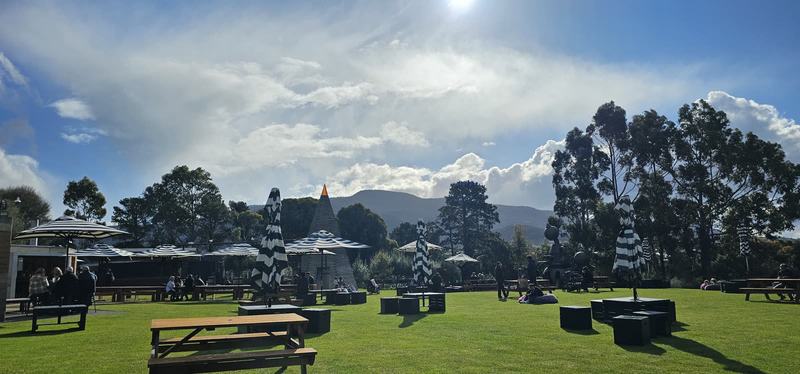
The lawn at MONA, with the mountain behind.
The bronze giant on the lawn is Tom Otterness's Girls Rule (2020). It's seven metres tall, and it's a children's playground: the slides come out of it.
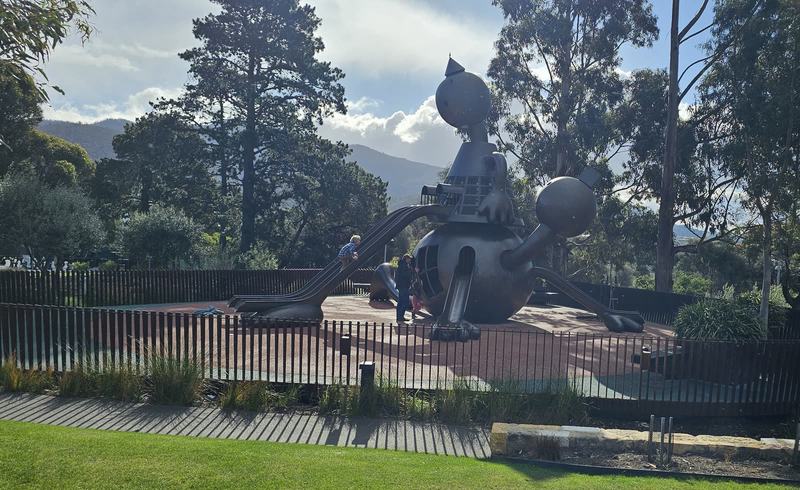
Tom Otterness, Girls Rule, 2020.
6. Under the bridge
Back from MONA, we went out on the water again: an evening cruise with Hobart Historic Cruises, from 5:20 to about 7:10. By the time the boat reached the Tasman Bridge, it was dusk, and the deck was lit green from end to end.
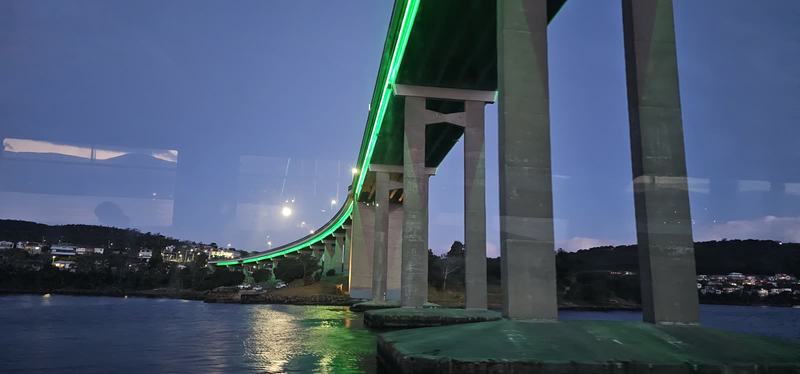
Under the Tasman Bridge, through the boat's window.
The bridge opened in 1964–65, 1,396 metres across the Derwent, joining the city to the eastern shore. The lights are permanent: nearly 2,000 LEDs, put up in 2019–21. People can book a colour for an event or a cause. What the green was for that night, we don't know.
On the night of 5 January 1975, a ship loaded with zinc ore, the Lake Illawarra, hit two of the piers. 127 metres of deck fell and the ship sank. Twelve people died: seven of the crew, and five in four cars that drove into the gap in the dark.
Hobart was cut in two. Nearly a third of the city lived on the eastern shore, and the way round by road was 50 km. Ferries were running across the river within an hour. The bridge didn't reopen until October 1977.
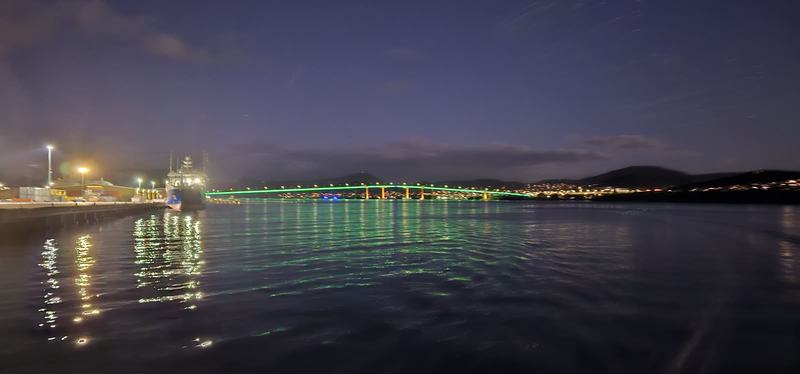
The Tasman Bridge from the water, past the wharves.
So the day ended the way Hobart got to work while the bridge was down: on the water.
Almost. I had one more thing, on my own: the 8:30 screening of the new Spider-Man film.
The idea, again
The warehouses were cut out of a cliff to hold what the sea paid for. The museum was cut into a cliff with what the betting paid for. Both times, Hobart spent the money on its waterfront, and both times, people came to see it.
Look for
- The quarry face behind the Salamanca warehouses.
- Kelly's Steps, cut into the same cliff as the warehouses.
- The cottages round Arthur Circus, built for officers.
- The sheep on the MONA ferry.
- **The holes in the side of *Artifact***, and what spins inside.
- The mountain behind Hobart from the ferry. That's Monday.
- The Tasman Bridge from underneath, from the water at dusk.
The short version
- 08:30 — Salamanca Market, in the whale-oil warehouses
- 10:15 — Kelly's Steps up to Battery Point and Arthur Circus
- 11:15 — The MONA ferry from Brooke Street Pier
- 12:00 — MONA: up the 99 steps, then down into the cliff
- 17:20 — An evening cruise with Hobart Historic Cruises, under the Tasman Bridge at dusk
- 20:30 — Spider-Man at the cinema, for one of us
Sources: Wikipedia (Salamanca Place, Salamanca Market, Kelly's Steps, James Kelly, Battery Point, MONA, David Walsh, Moorilla Estate); The Hobart Magazine, "The origins of Salamanca"; MONA's ferry page; Parks Tasmania (Freycinet); Wikipedia (Tasman Bridge, Tasman Bridge disaster); City of Clarence (history); ABC News (the bridge's 50th anniversary); MONA (Siloam, Void Bar); Art Monthly Australia (Siloam); Wilfredo Prieto's gallery, Prats Nogueras Blanchard; Sculpture magazine (Barsamian); The Art Newspaper and UAP (Otterness).