The port that missed the boat
Geelong, Victoria — read on Sunday night at Rydges, or Monday morning before the walk.
Geelong, Victoria — read on Sunday night at Rydges, or Monday morning before the walk.
Tomorrow afternoon at a quarter past four you'll put your bags in a taxi and ride ten minutes north to a working wharf at Corio Quay, where a ship will take you to Tasmania. There is a joke buried in that taxi ride, and it is about a hundred and seventy years long. Geelong is the punchline.
Corayo, before any of it
Long before there was a Geelong there was Corayo — the bay — and the people of the Wadawurrung, who have lived around it for tens of thousands of years. The name of the city is usually traced to a Wadawurrung word recorded by early settlers as Djilang or Jillong, and the meaning most often given is "tongue of land" or "cliffs", which fits: the whole town sits on a low tongue of land poking into a shallow bay.
The Barwon River, which loops around the southern edge of the city, was the larder. Eels ran down it every autumn, and the Wadawurrung trapped and smoked them and travelled to meet other clans while the run was on. Some of the stone eel traps in this part of Victoria are among the oldest known engineering works anywhere on earth. When you stand on Eastern Beach looking out at flat grey water and it seems like a pleasant but unremarkable view, remember that you are looking at somebody's kitchen, and it has been in the family for about two thousand generations.
The town that should have been Melbourne
Europeans arrived in the 1830s, and for about twenty years Geelong had a very good case for being the most important place in the colony. It had the wool of the Western District behind it — the very country you came through on the train this morning, past Hamilton and Camperdown and Colac — and after 1851 it had something even better: it was the closest port to the Ballarat goldfields. Diggers landed here. Gold went out through here. The town tripled, filled up with bluestone, and got extremely sure of itself.
Then it lost. The bay was shallow, and the channel needed constant dredging that the colonial government was slow to fund. Melbourne had the Yarra, the railways, the parliament and the banks. By the 1860s the gold traffic had shifted, and Geelong — which had been calling itself "The Pivot", as in the pivot on which the whole colony turned — was quietly demoted to a large regional city. The name stuck anyway, with the stubbornness of a town that refuses to update its own press release. The football club was the Pivotonians long before it was the Cats.
There is something likeable about a place that spent its formative years coming second. It made Geelong practical rather than grand.
Wool, and why Tasmania is already in this story
What it did instead was wool, on a scale that is hard to picture now. Enormous bluestone wool stores went up along Moorabool Street, and the wool sales here set prices that were read in Yorkshire and Bradford. "Geelong lambswool" is still a term of art in knitwear catalogues on the other side of the world, which is a strange sort of immortality for a town that hasn't sold a bale in decades.
One of those wool stores, an 1870s bluestone barn on Moorabool Street, is now the National Wool Museum — the rainy-day option in tomorrow's note. Go in if the weather turns, because it makes the link to the rest of your trip obvious: a great deal of the superfine merino that came through here came across Bass Strait, off Tasmanian properties in the Midlands. The country you'll drive through on Friday between Launceston and the coast was growing the fibre; Geelong was selling it. The two ends of your itinerary were already in business together before either of you was born.
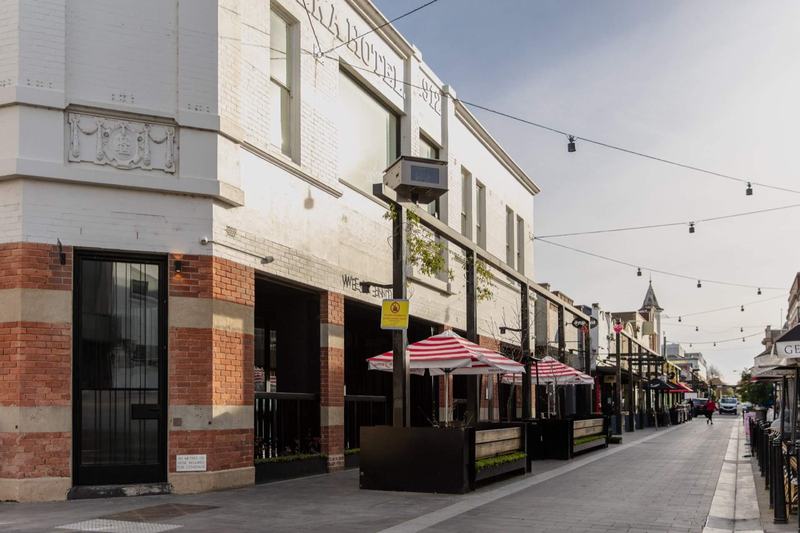
Little Malop Street, where dinner is. Photo: Visit Geelong & The Bellarine.
A century of making things, and then not
The twentieth century made Geelong an industrial town. Ford opened here in 1925 and built engines and bodies for the better part of a century. An aluminium smelter ran at Point Henry from the sixties. An oil refinery went up at Corio and is still there — you'll see its flare and tanks from the taxi tomorrow, which is a very Geelong way to be farewelled.
Then, quickly, it ended. The smelter closed in 2014. Ford's Australian manufacturing, Geelong included, stopped in 2016. Towns don't usually survive that twice in three years, and plenty of people expected this one to hollow out.
It didn't, quite. Deakin University grew into the gap, the carbon fibre research here is genuinely world-class, and in 2017 Geelong was named a UNESCO City of Design — Australia's first. Whether that feels like adequate compensation for a car plant probably depends on whether your father worked at the car plant. But the town is still here, and it is unmistakably trying.
The bollards, and deciding to be liked
Which brings us to the thing you'll actually walk past tomorrow.
In the mid-1990s, when the old Yarra Street Pier was pulled down, the city kept the timber pylons and handed them to an artist named Jan Mitchell, who painted them into more than a hundred characters from Geelong's history: bathing belles, a town band, lifesavers, sailors, footballers, a dour-looking mayor or two. They stand along the foreshore in little clusters, and they are cheerful in a way that municipal public art almost never manages.
Nearby there's an 1892 steam carousel, hand-carved, still turning under a glass pavilion. And at Eastern Beach, the 1930s art deco sea baths — a curved concrete promenade and a netted swimming enclosure, restored in the nineties after decades of neglect.
Notice what all three have in common. They are all old working things that were saved and made charming. Pier timbers. A fairground ride. A municipal swimming pool. This is what a town builds when it has stopped being a port that ships wool and started being a place that would like you to stay for the weekend. The bollards are not history. They are a town's decision about what to do next.
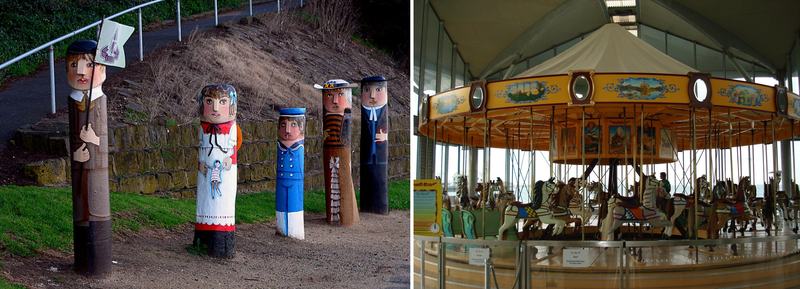
Left: painted bollards by Jan Mitchell. Photo: Bernard Spragg, Wikimedia Commons, public domain. Right: the 1892 carousel. Photo: sri_the_quack, Wikimedia Commons, CC BY-SA 2.0.
.jpg)

And then the boat came back
Here is the ending.
For decades the Tasmanian ferry sailed from Station Pier in Port Melbourne — Melbourne's berth, in Melbourne's bay, exactly as the nineteenth century decided it should be. Then in October 2022 the Spirit of Tasmania moved its whole operation to Geelong.
So the ship that Geelong lost the argument about, in the 1850s, now leaves from Geelong. The quay that once loaded Western District wool for England loads Tasmanian holiday traffic instead — tomorrow night, that's you. The town missed the boat by a century and a half, and then the boat came back and parked.
It's worth thinking about as you board. You are not taking a ferry from a random regional city. You're leaving from a port that spent a hundred and seventy years waiting for exactly this.
While you're out tomorrow
- On the bollards: look for the bathing beauties and the town band. Jan Mitchell painted characters, not monuments — nobody here is on a horse.
- At Cunningham Pier: it started life as Railway Pier in the 1850s, built to move gold and wool. Having lunch on it is a fairly recent idea.
- At Eastern Beach: the concrete curve is 1930s Depression-era public works. Somebody's grandfather was paid a shilling to build the thing you're sitting on.
- At the Wool Museum, if it rains: find the Tasmanian wool. It's the first day of your trip that's really about the last week of it.
- In the taxi at 16:15: the refinery on your right is the last working piece of industrial Geelong you'll see, and the quay you're heading for is the newest.
If you want to read further
中文版:錯過那艘船的港口