The city that faces south
Mawson sailed from here in 1911. Amundsen cabled the news of the South Pole from here in 1912. The orange icebreaker still calls Hobart home. A free day on foot in the last city before Antarctica.
Most cities face their own country. Hobart faces south.
For more than a hundred years, it has been the last city before Antarctica: the place expeditions leave from, and the place they come back to. Cape Denison, where Mawson built his huts, is about 3,000 km due south.
Today has no schedule, just a map of places to wander between. But look at the map again and there's a thread running through it, from the waterfront to the museum to a glasshouse in the Gardens. It all points south.
The map
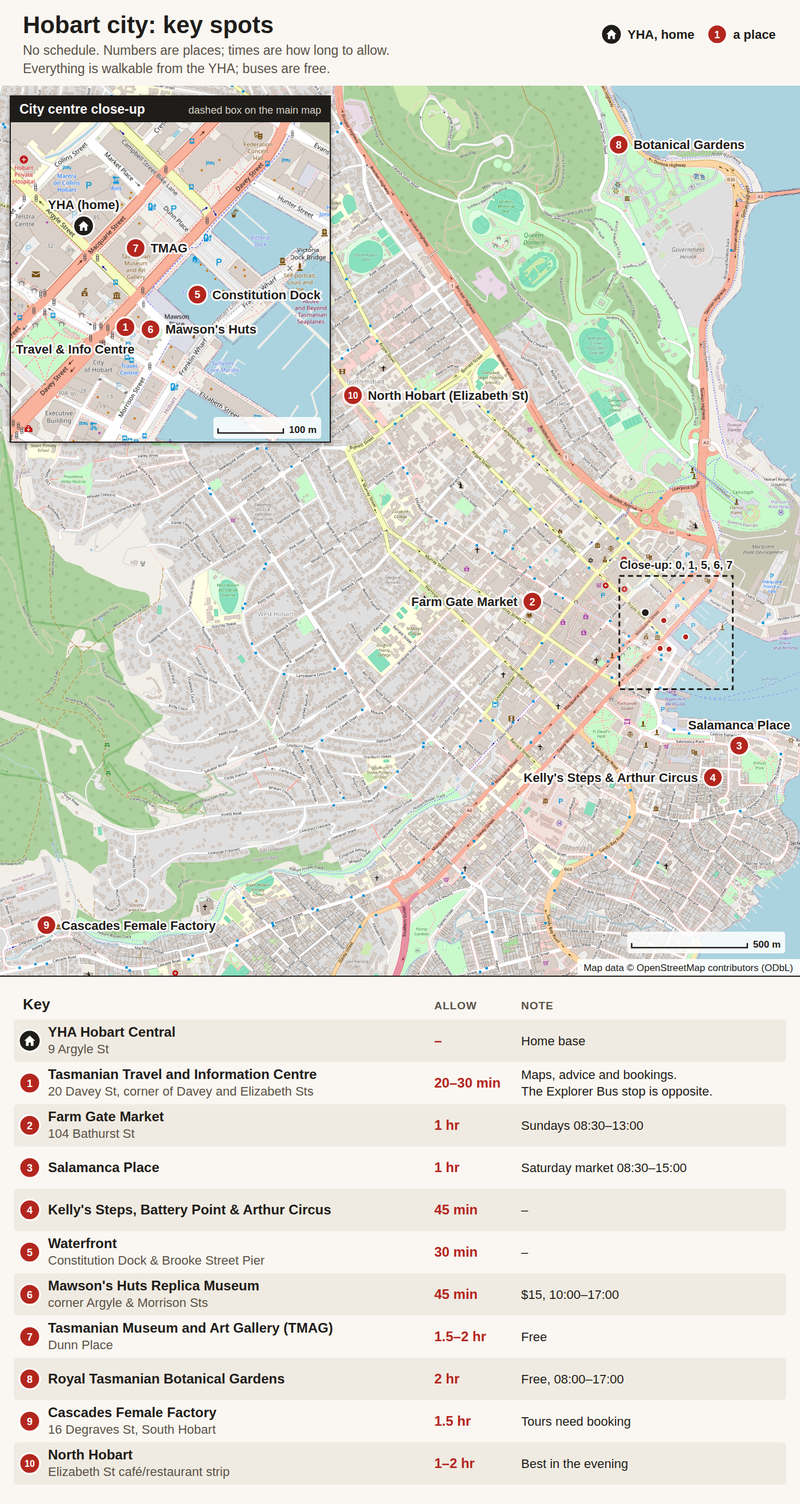
Ten spots and how long to allow at each. Map data © OpenStreetMap contributors (ODbL).
1. The send-off, 2 December 1911
In November 1911 a ship called the Aurora tied up at Queens Wharf in Hobart. She was carrying Douglas Mawson and the Australasian Antarctic Expedition. On 2 December she left, with what one account calls "a tumultuous dockside send-off".
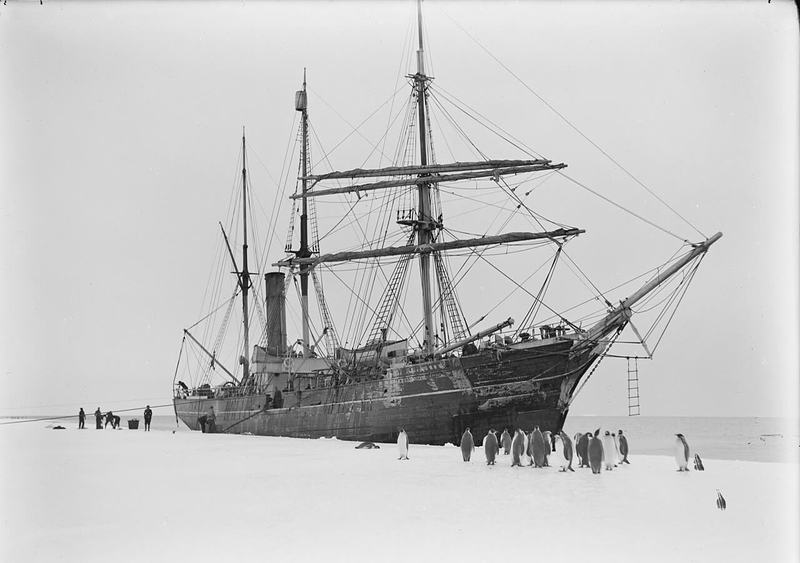
The Aurora, moored to the ice off the expedition's Western Base, 1913. Photo: Frank Hurley, Wikimedia Commons, public domain.

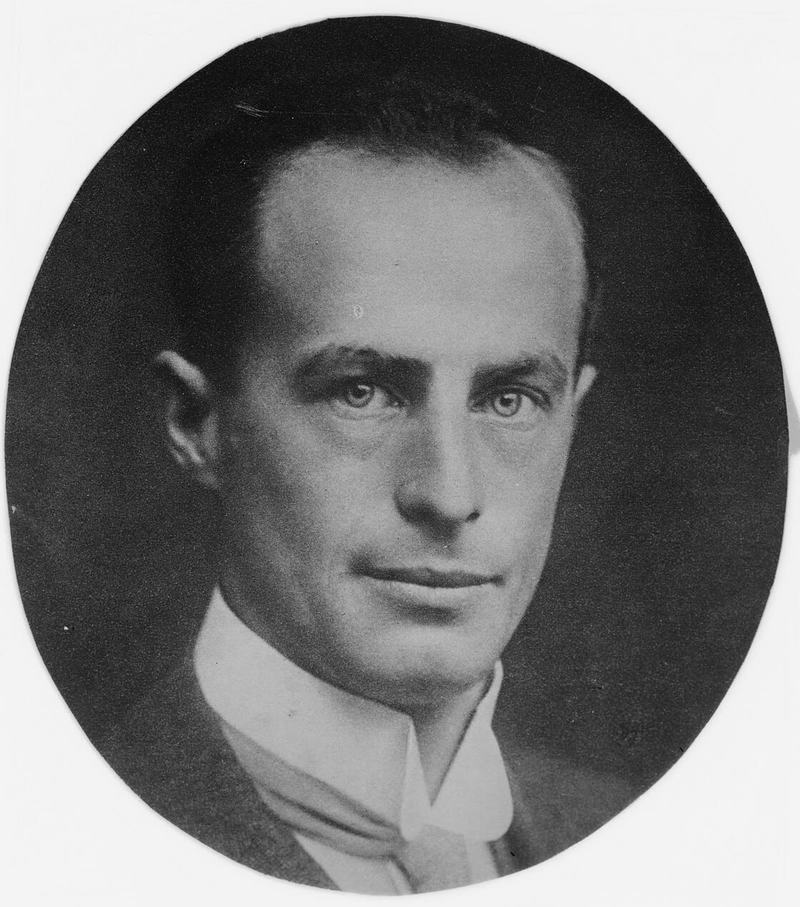
Douglas Mawson, 1915. Photo: Bain News Service, Wikimedia Commons, public domain.

On 8 January 1912 the ship came into a bay on the Antarctic coast. Mawson named it Commonwealth Bay, and the main base went up at Cape Denison.
2. The walk back
On 10 November 1912 Mawson set out east with two companions, Belgrave Ninnis and Xavier Mertz: the Far Eastern Party.
On 14 December, Ninnis fell into a crevasse. Mertz died on 8 January 1913.
Mawson walked on alone. On 1 February he reached a supply cave the expedition called Aladdin's Cave, and a blizzard held him there for a week. The Aurora sailed for home on 8 February, just hours before he made it back to the huts. He spent another whole winter at Cape Denison, and only got home in December 1913.
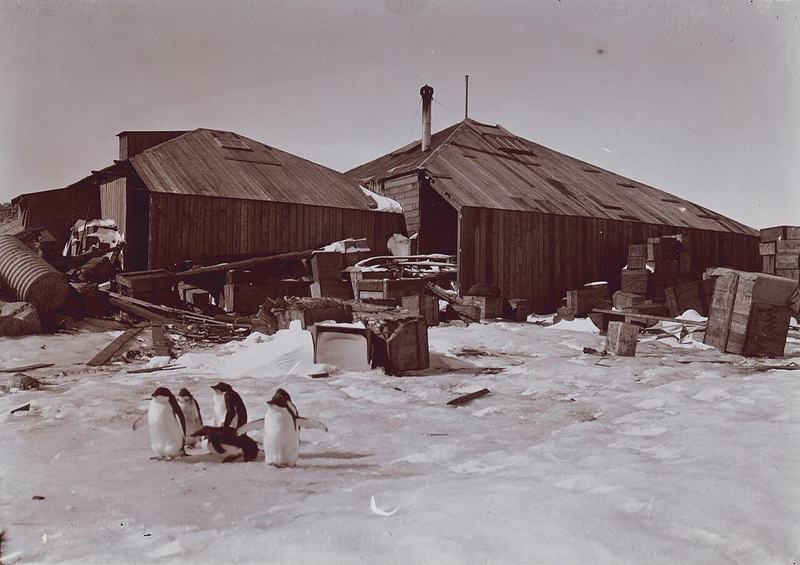
The main base at Cape Denison, 1912. Photo: Frank Hurley, Wikimedia Commons, public domain.

3. A hut on the waterfront
The real huts are still at Cape Denison. Keeping them standing in that wind costs money, which is why there's a second hut, opposite Constitution Dock (spot 6 on the map).
The Mawson's Huts Replica Museum opened on 2 December 2013, the 102nd anniversary of the Aurora's departure. It was built to raise money to conserve the originals. The ABC described it as a full-scale timber hut with the exact dimensions of the original, and the Baltic pine came from the same part of Scandinavia as Mawson's did in 1911.
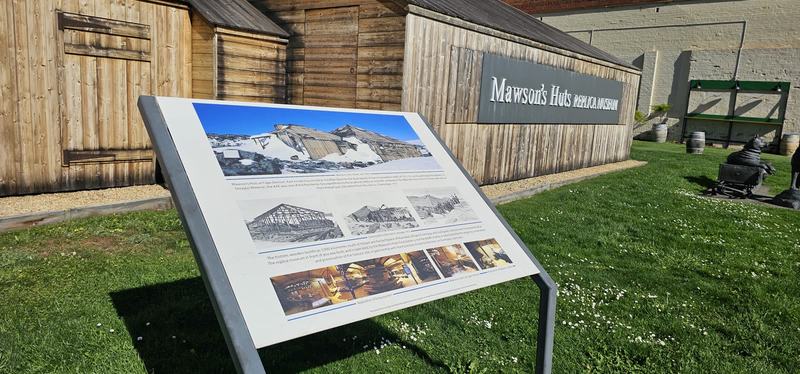
Outside the replica. The sign shows the real huts at Cape Denison, half buried in snow.
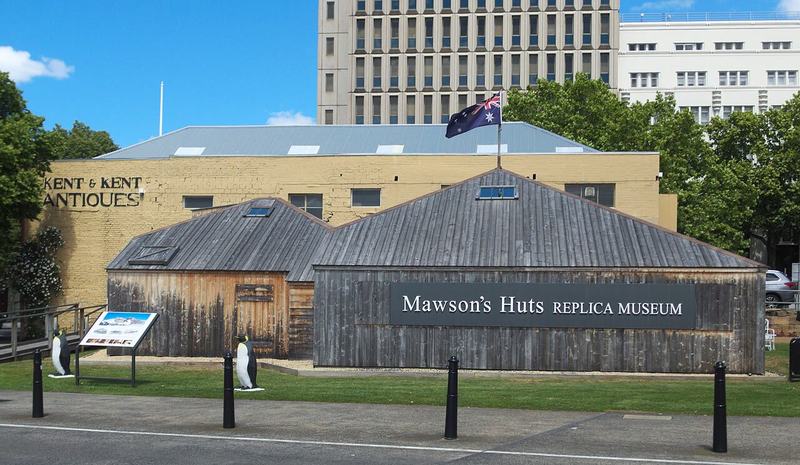
The replica, opposite Constitution Dock. Photo: Gary Houston, Wikimedia Commons, CC0.

It's $15 to go in. Step inside and imagine wintering in it, 3,000 km south.
We went in on 29 September, our last morning in Hobart, before the flight to Melbourne. At Cape Denison, the Australian Antarctic Division says, the main room was about 7.3 metres square, with a long central dining table and the men's bunks around the walls.
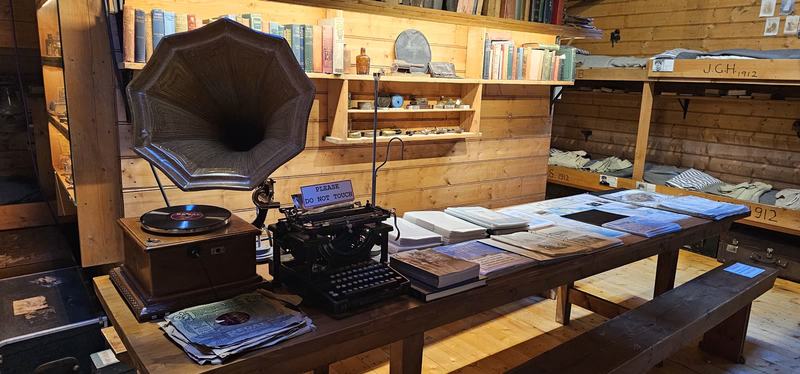
Inside the replica, on our visit on 29 September: the long table, with a gramophone and a typewriter, and bunks marked with initials and the year behind.
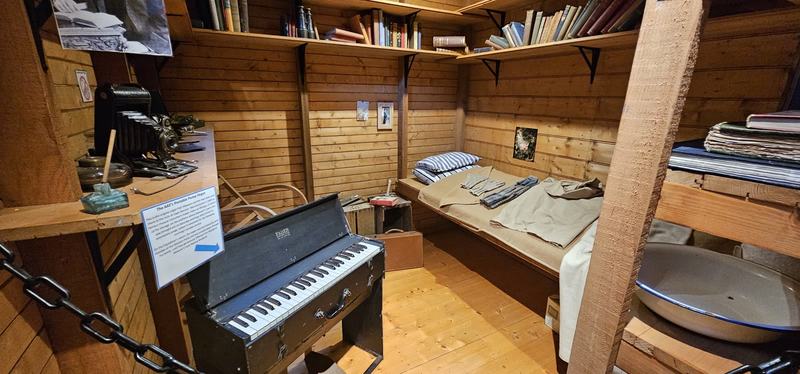
Mawson's room in the replica (our visit, 29 September), with the expedition's portable pump organ. Its sign says it was made in 1909, went to Cape Denison with the men, and came out after dinner on Saturday evenings to accompany songs.
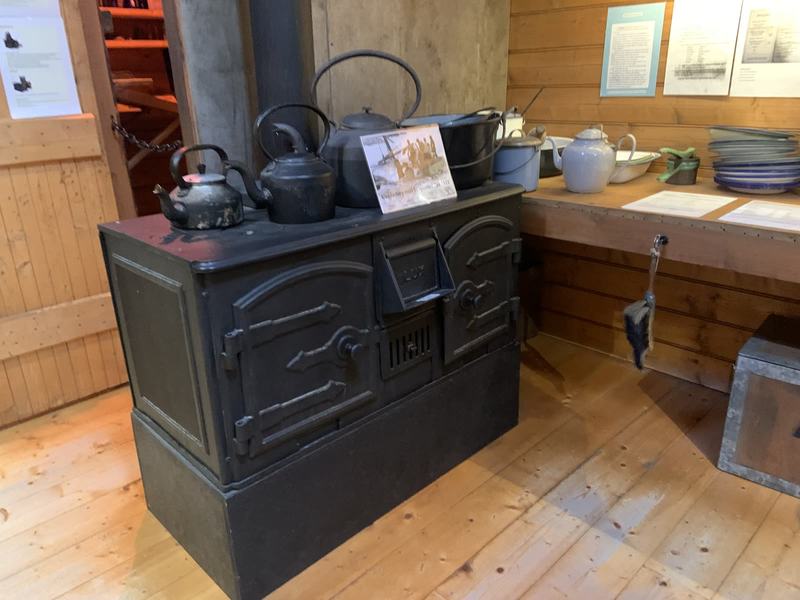
The replica's kitchen corner (our visit, 29 September). At Cape Denison the stove was, in the Antarctic Division's words, the "centrepiece for many a conversation".
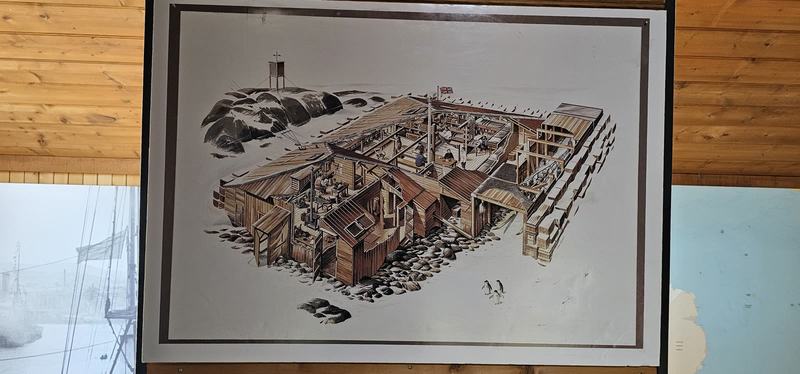
A cutaway drawing of the huts at Cape Denison, on the wall of the replica (our visit, 29 September): the men at the long table and at their benches, snow banked round the walls.
4. The telegram, March 1912
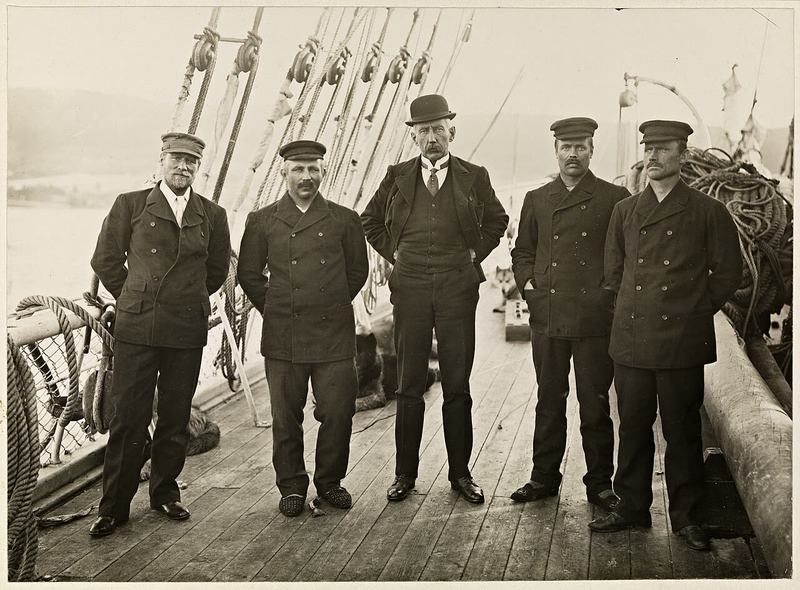
Three months after the Aurora left, another polar ship came up the Derwent. On 7 March 1912 the Fram reached Hobart with Roald Amundsen on board. He had been to the South Pole.
The five men who reached the Pole, on the Fram's deck on arrival in Hobart, March 1912. Amundsen is in the middle. Photo: National Library of Norway, via Wikimedia Commons, public domain.

Hobart was the first place he could tell anyone. He telegraphed his brother Leon, the explorer Fridtjof Nansen and King Haakon of Norway. The next day he cabled the full story to the Daily Chronicle in London. So the news that a human had reached the South Pole went out to the world from Hobart.
He stayed at Hadley's Orient Hotel, which is still on Murray Street, a few minutes from the YHA. The Fram stayed two weeks, and for part of that time the Aurora, back from Antarctica, was in port with her.
There's a sculpture of Amundsen by the water, outside the IMAS building on Castray Esplanade, near Salamanca.
5. The ice in the museum
At the Tasmanian Museum and Art Gallery (spot 7), the Antarctic gallery is called Islands to Ice. It's described as holding the oldest known Antarctic sled, penguins, and real ice cores drilled out of the ice sheet.
TMAG is free, and open Tuesday to Sunday, 10 to 4, from April to December.
6. An island in a glasshouse
The Royal Tasmanian Botanical Gardens (spot 8) were founded in 1818, the second-oldest botanic garden in Australia. In one corner is the Subantarctic Plant House, built to recreate Macquarie Island in the Southern Ocean: the plants, and the fog, with a painted backdrop and a soundscape.
The Gardens' Conservatory is closed for restoration, due to reopen this spring. The notice doesn't mention the Plant House, but it doesn't give its hours either, so it may or may not be open when you get there.
7. Still the gateway
The expeditions never stopped. Australia's Antarctic Division has had its headquarters at Kingston, just south of Hobart, since 1981.
Its icebreaker, **RSV Nuyina, is 160 metres long and bright orange. It arrived in Hobart for the first time on 16 October 2021** and tied up at Macquarie Wharf, five minutes from the city centre. Nuyina means southern lights in palawa kani, the Tasmanian Aboriginal language.
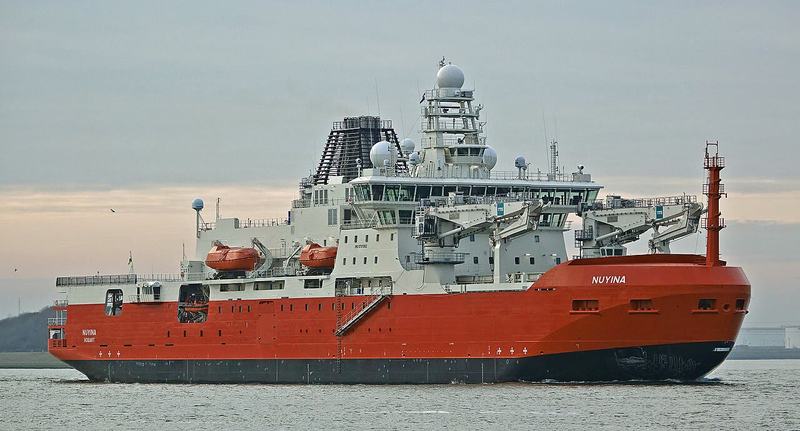
Nuyina off the Netherlands in March 2021, months before it first reached Hobart. Photo: kees torn, Wikimedia Commons.jpg), CC BY-SA 2.0.
It probably isn't in port today. The Division's schedule has it arriving back in Hobart on 14 October, when its season begins.
France has used Hobart for its own Antarctic program since the 1950s. The Tasmanian Government says the Antarctic sector is worth more than $204 million a year to the state, with more than 1,100 jobs. The Antarctic Division says Hobart has the world's highest concentration of Antarctic and Southern Ocean research scientists.
8. The day, as it went
We started at the water just after nine. Constitution Dock was flat calm.
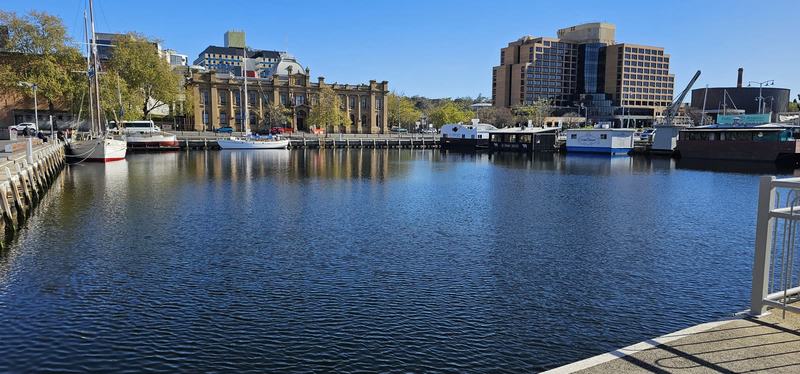
Constitution Dock, just after nine.
By Brooke Street Pier, two bronze animals ride a tandem bicycle, one with binoculars, the other holding up an apple.
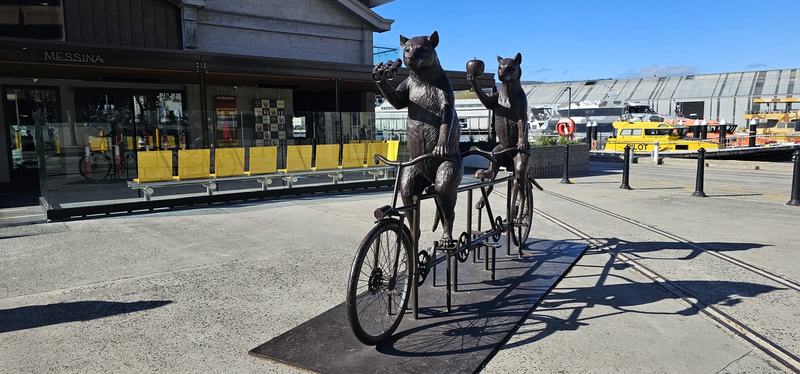
By Brooke Street Pier.
Then the hut, pictured in section 3 above. The sign outside shows the real ones at Cape Denison, half buried in snow.
By ten, Farm Gate Market had taken over Bathurst Street.
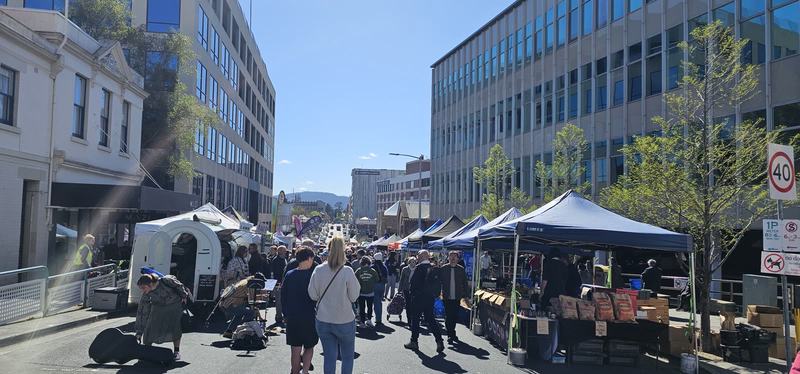
Farm Gate Market.
After lunch we headed up towards the Gardens, and the Derwent kept showing itself between the gums.
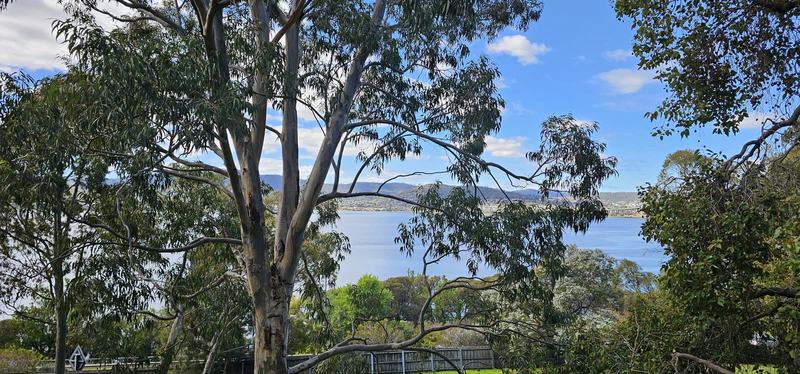
The Derwent through the gums, on the way up to the Gardens.
From the slopes above the river, the Tasman Bridge we'd gone under on Saturday night looked like a different bridge in daylight.
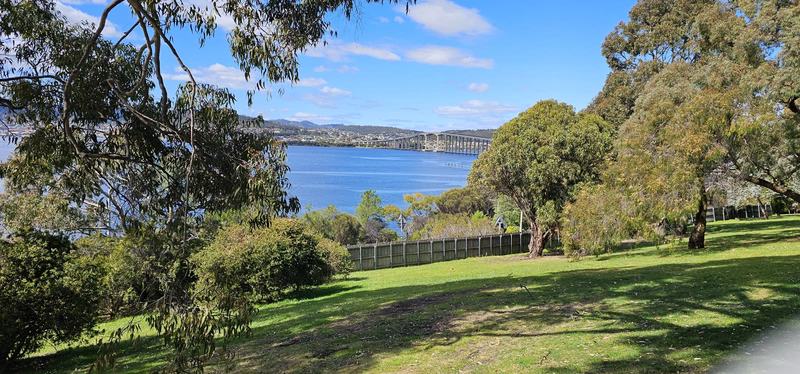
The Tasman Bridge by day.
On the grass was a Tasmanian native-hen, a flightless bird found only in Tasmania.
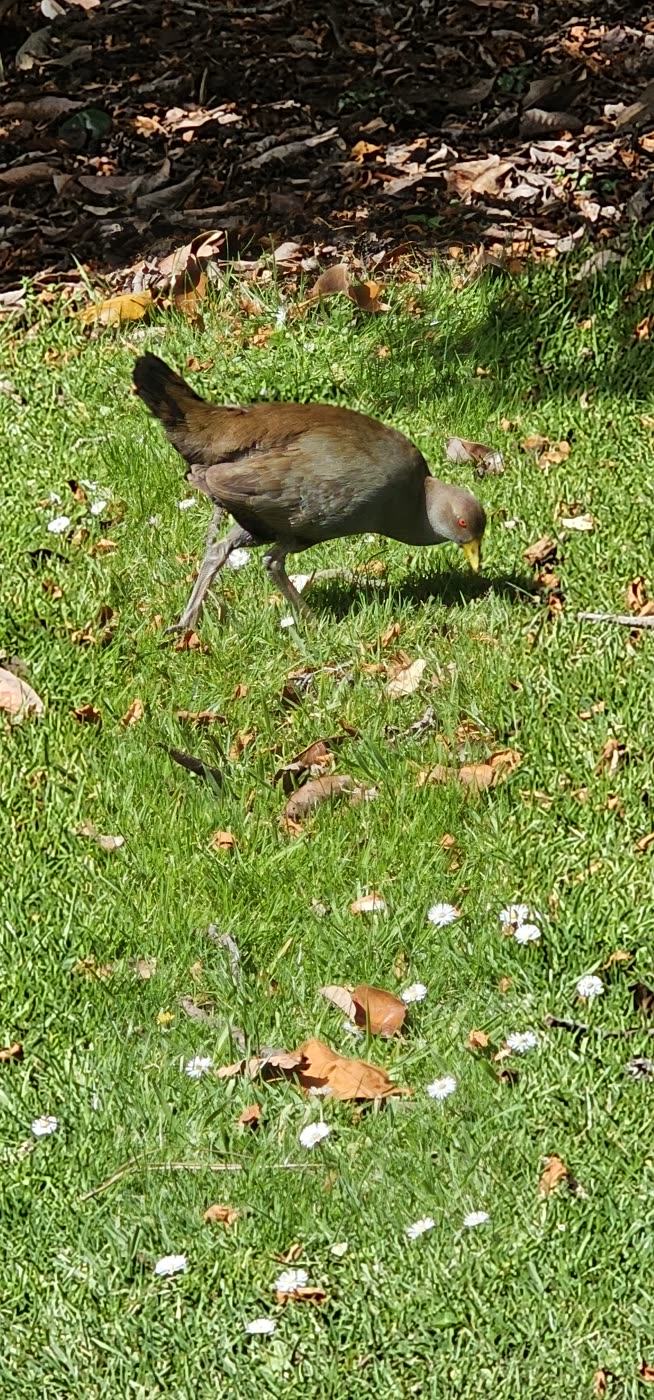
A Tasmanian native-hen.
In the Gardens we ended up in the Japanese Garden rather than the Subantarctic Plant House. We didn't make it to TMAG either; it's open again on Tuesday, before the flight.
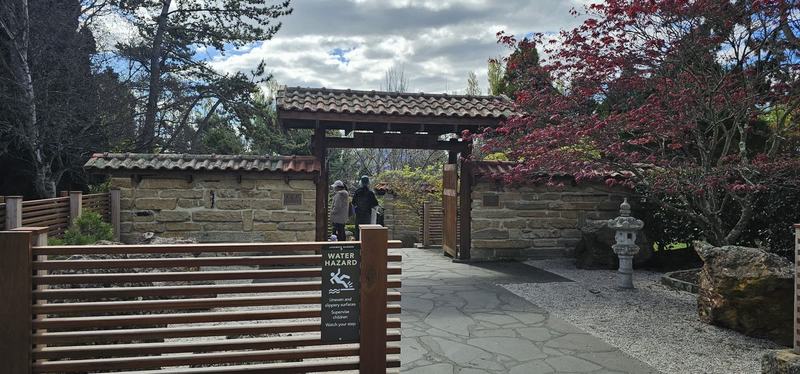
The Japanese Garden, Royal Tasmanian Botanical Gardens.
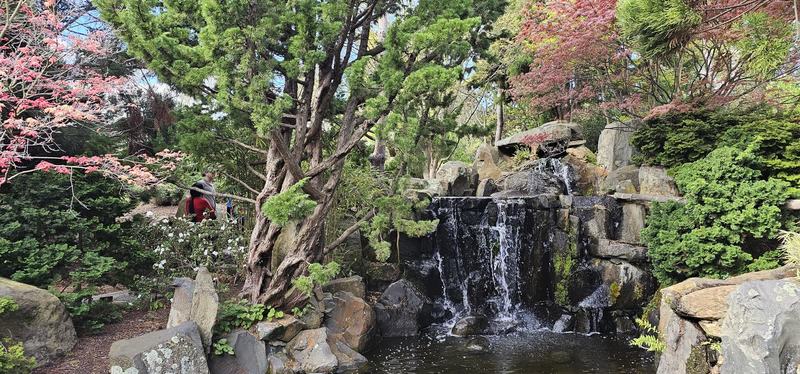
The waterfall in the Japanese Garden.
In the evening we walked back through Salamanca, down a laneway between Saturday's warehouses, past a giant chess set in a courtyard.
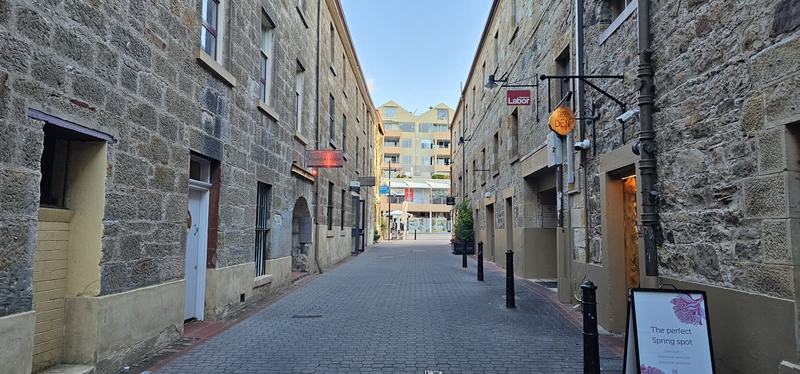
A laneway through the Salamanca warehouses.
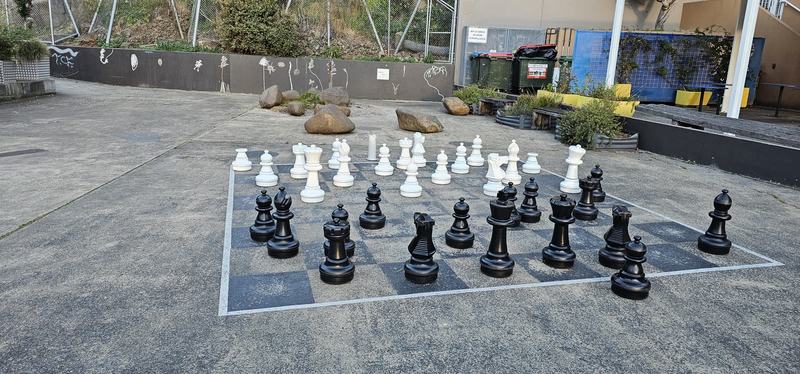
A giant chess set near Salamanca Square.
And in Salamanca Square, the day's last photo turned out to be on theme after all. The fountain is Stephen Walker's Journey to Southland, made in 1979 and first put up at Risdon Cove. "Journeys to the Southland" is cast into the bronze.
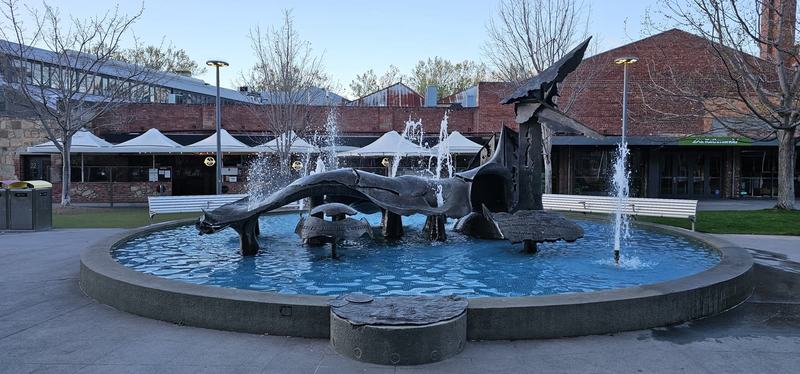
Journey to Southland, Salamanca Square.
The idea, again
Hobart's waterfront isn't just the end of Tasmania. It's the start of the road south. Mawson's send-off, Amundsen's telegram and the orange ship at Macquarie Wharf are the same story, told a hundred years apart. Walk it today with no schedule and no ship to catch, and you'll keep finding it.
While you're out
- Mawson's Huts Replica, opposite Constitution Dock: the Baltic pine, and how small it is for a winter.
- Hadley's Orient Hotel, 34 Murray St, where Amundsen stayed in 1912.
- The Amundsen sculpture outside the IMAS building, 20 Castray Esplanade, near Salamanca.
- The oldest known Antarctic sled, in Islands to Ice at TMAG.
- Macquarie Wharf: look for an orange hull, though it's probably not due until mid-October.
- The Subantarctic Plant House in the Gardens, if it's open.
The short version
No schedule. These are the spots on today's map with a southern thread:
- 5 Waterfront — 30 min · Where the Aurora and the Fram came in
- 6 Mawson's Huts Replica — 45 min · The hut, full size
- 7 TMAG — 1.5–2 hr · Islands to Ice
- 8 Botanical Gardens — 2 hr · Macquarie Island under glass
Sources: Wikipedia (Australasian Antarctic Expedition, Far Eastern Party, Amundsen's South Pole expedition, Mawson's Huts); Mawson's Huts Foundation (the replica museum, the expedition); ABC News (the replica, 2013); Australian Antarctic Division, Home of the Blizzard (the main hut at Cape Denison); ABC Radio (the pump organ, made in 1909); Tasmanian Polar Network (Hadley's, TMAG); Hadley's Orient Hotel; Monument Australia (the Amundsen sculpture); Australian Antarctic Division (headquarters, Nuyina, its home port and name, the 2026–27 shipping schedule); Mirage News (Tasmanian Government release, March 2026); Discover Tasmania (TMAG hours); Royal Tasmanian Botanical Gardens (heritage, the Subantarctic collection, current projects); Wikipedia, List of public art in Tasmania (Journey to Southland).