Weindorfer's mountain
An Austrian botanist stood on a Tasmanian summit in 1910 and said a sentence. Everything you see at Dove Lake today follows from it.
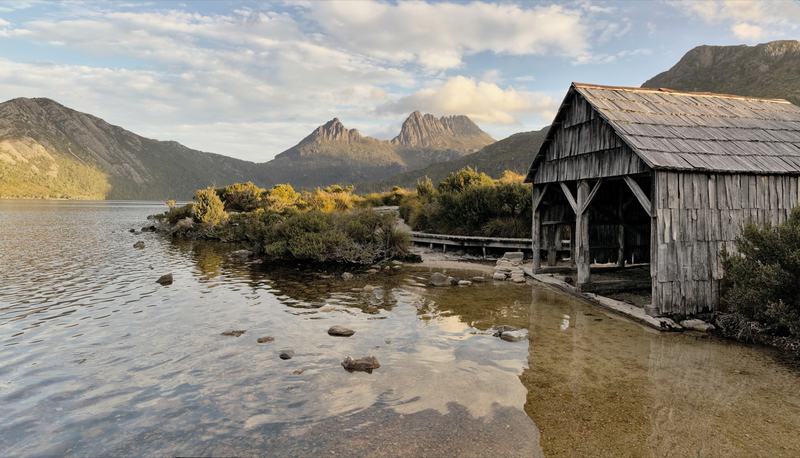
Two hours west of Launceston there is a mountain that exists as a national park because one man said so, out loud, standing on top of it.
Here's who he was, and what to look for once you're there. But first, a cave.
The map
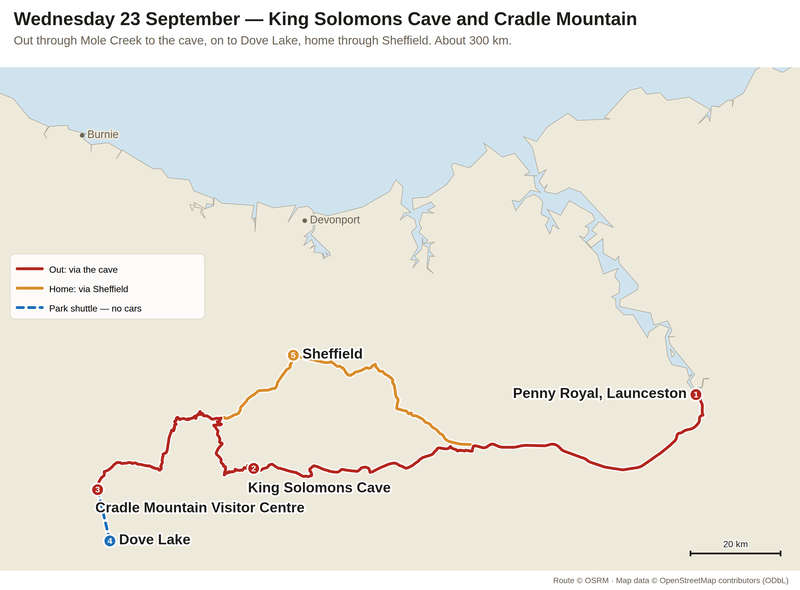
Out via Mole Creek and the cave, home via Sheffield — about 290 km. The dashed leg is the park shuttle; cars stop at the Visitor Centre. Route via OSRM, map data OpenStreetMap contributors.

Budget, Wellington Street, first thing. We booked "a Camry or similar". This is the similar.
1. King Solomons: the sparkling cave
You start underground.
The plan said Marakoopa, the cave with the glow worms. We ended up in King Solomons instead: the other show cave in the Mole Creek Karst National Park, seven kilometres further along the road to Liena.
Mole Creek Karst is the only national park in Tasmania created specifically to protect karst: limestone country of gorges, sinkholes and caves. In 1906 a paling splitter, a man who split timber into fence palings, stumbled across this one. The tourism potential was obvious. By 1912 Marakoopa was open to the public, and by the 1920s the state's Tourism Department was buying up the land at the cave entrances.
Marakoopa is big, with two streams running through it. King Solomons is compact and dry. What it has instead is decoration: stalactites, stalagmites, shawls (thin curtains of calcite hanging in folds), and calcite that sparkles under the tour lights. The name promises King Solomon's treasure. The walls come close.
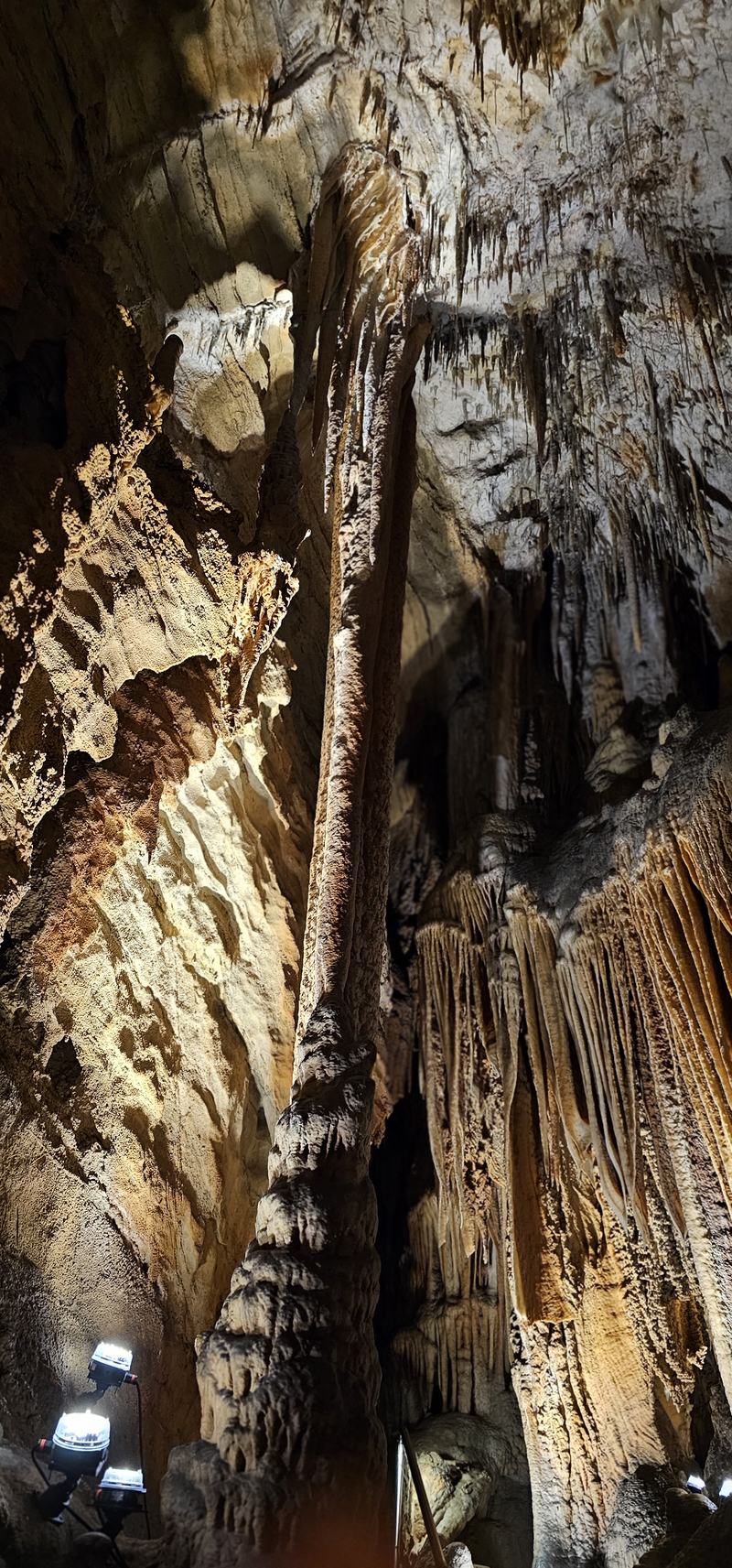
A column: a stalactite and a stalagmite that grew until they met.
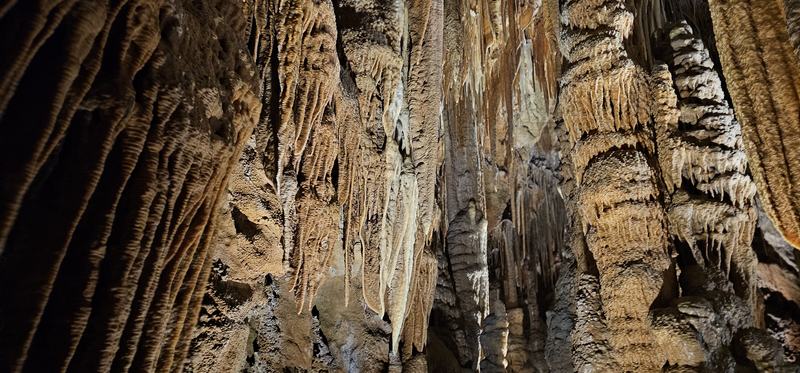
Shawls and stalactites. Photography is allowed here, flash included. At Marakoopa it isn't allowed in the glow-worm chamber, which is the main reason this post has cave photos at all.
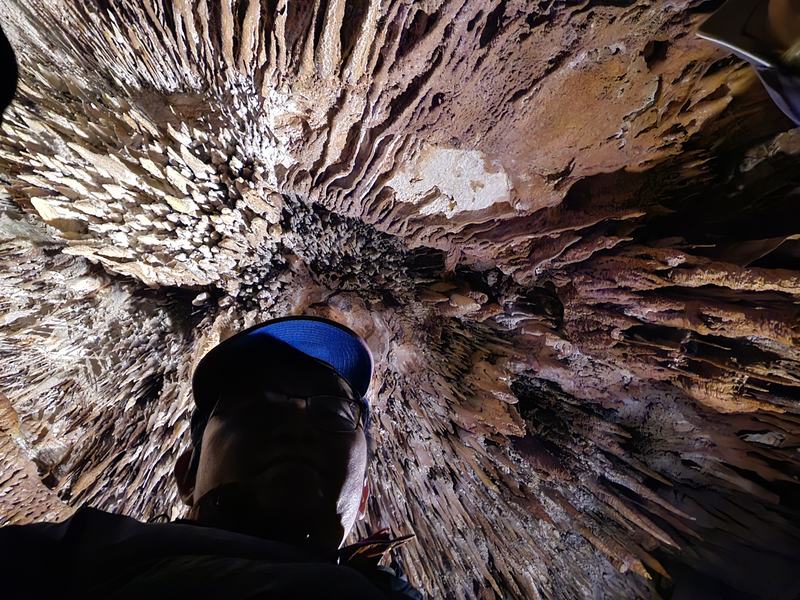
Looking straight up.
The tour is forty-five minutes, $32 each, and fine for any level of fitness.
2. The name is a mining joke
The mountain got its name in 1827 from Joseph Fossey, a surveyor for the Van Diemen's Land Company, who thought the dip between the main summit and Little Horn looked like a miner's cradle — the rocking box used to wash gold from gravel.
So the most photographed profile in Tasmania is named after a piece of equipment. It's 1,545 metres, dolerite, and the shape is the reason every photograph from Dove Lake looks like every other photograph from Dove Lake. That's not a criticism. It's a very good shape.
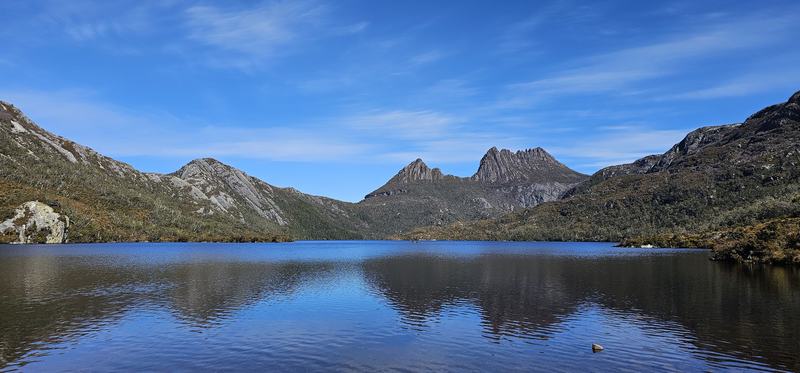
The shape, from the shore of Dove Lake. Wednesday was clear.
The mountain has four named summits. One of them is Weindorfers Tower, 1,459 metres. The man in the next section got a peak.
3. The sentence
Gustav Weindorfer arrived in Melbourne from Austria in 1899, aged twenty-five. Four years later he met Kate Cowle, a Tasmanian botanist and climber, and they married in 1906. She was the local; he was the enthusiast.
In 1910 they climbed Cradle Mountain together — Kate is recorded as the first Australian woman to reach the summit — and on the top, Weindorfer said:
"This must be a national park for the people for all time. It is magnificent, and people must know about it and enjoy it."
That is the founding sentence of everything at Dove Lake.
He meant it literally. In 1912 he started building a chalet from King Billy pine on land Kate owned in the valley below, and named it Waldheim — "forest home". It opened to guests in the summer of 1913: no road, no electricity, a day's walk in, and Weindorfer cooking. People came anyway.
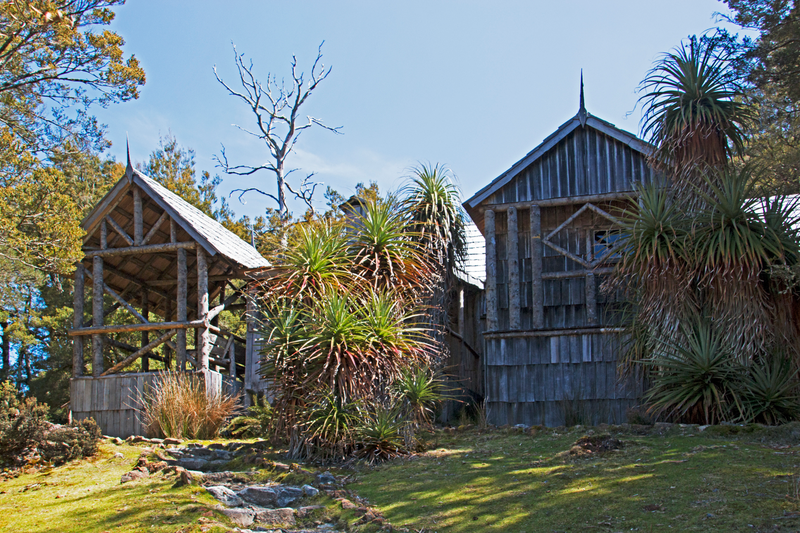
Waldheim. The building standing today is a faithful rebuild from the 1970s; the original had rotted. Photo: H.-U. Küenle, Wikimedia Commons, CC0.

4. What it cost him
Kate died in 1916. Weindorfer stayed on the mountain alone.
During the First World War, an Austrian living by himself in a remote valley attracted exactly the suspicion you'd expect; neighbours reported him as a possible spy. He kept going. In 1921 he toured Tasmania with a slide projector, arguing for the park to anyone who'd sit still. In 1922, 158,000 acres between Cradle Mountain and Lake St Clair were proclaimed a scenic reserve.
He died at Waldheim in 1932, and is buried there. The reserve became a national park in 1971 and part of the Tasmanian Wilderness World Heritage Area in 1982 — the "for all time" part of the sentence, delivered fifty years late.
The raven that wasn't
At the Visitor Centre, a black bird walked up the path after us. Then it kept walking after us, all the way to the shuttle stop.
We called it a raven. It isn't one. Look at the eye: bright yellow, where a raven's is white. Then look at the white tips on the tail. It's a black currawong, Strepera fuliginosa, found only in Tasmania and the islands of Bass Strait. Fuliginosa is Latin for sooty, which is fair.
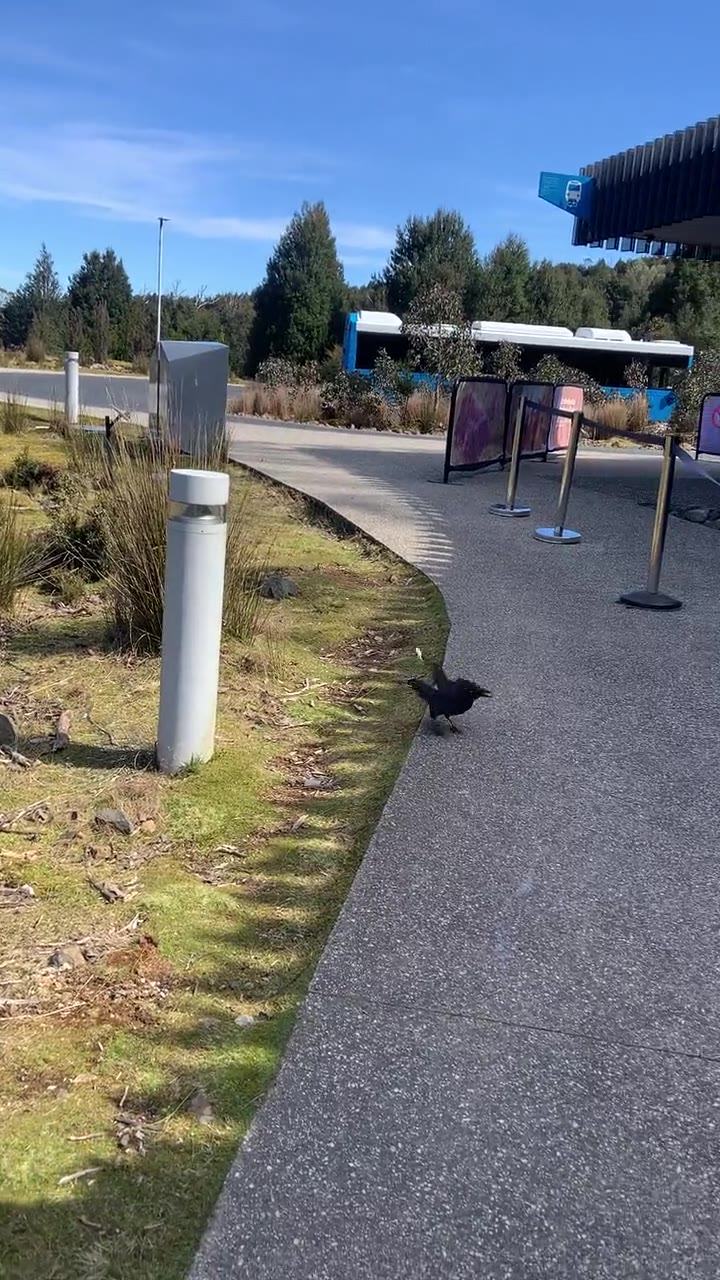
Our video, ten seconds: the currawong on the path to the shuttle stop. The bus behind it is the shuttle.
Currawongs at Cradle Mountain have worked out what tourists are for. They're known for snatching food from picnic tables and going through campers' things. This one wasn't following us. It was following the chance of lunch.
5. The boat shed is younger than you think
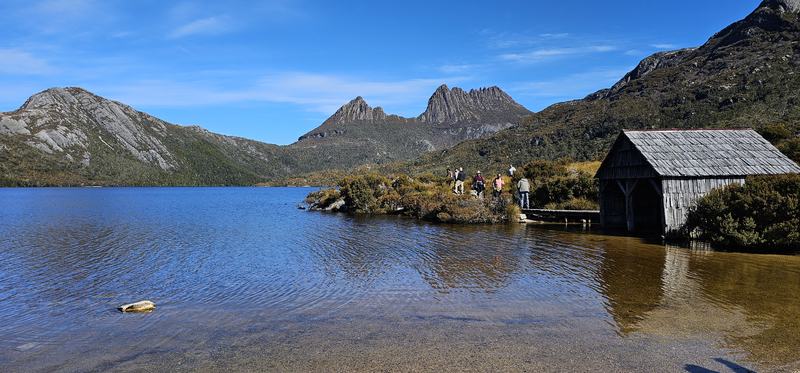
The photograph. Ours, this time.
The boat shed on the shore of Dove Lake looks like it has always been there. It was built in 1940 by Lionel Connell, the park's first ranger, out of the same King Billy pine as Waldheim, to keep rowing boats for visitors. The boats were used into the 1960s. The shed is empty now and has been for decades — it survives because it is the picture.
It is a few minutes' flat walk from where the shuttle drops you. Go there first, before anything else, while the light is on the mountain.
6. Sheffield, on the way home
The road home from Cradle drops through Sheffield, and the first thing you notice is that the buildings are covered in pictures.
There's a reason. In the 1960s and 70s Sheffield was a hydro town — the Mersey-Forth power scheme was being built in the hills above it, and the workers filled the shops and the pubs. When the scheme finished, the workers left, and the town started to die the way small towns do: slowly, then all at once.
In the mid-1980s two locals, Alan Dyer and Beth Pagel, watched a documentary about Chemainus, a timber town in British Columbia that had saved itself by inviting artists to paint its walls. They decided Sheffield could do the same.
The first mural was finished on 13 December 1986. It's called Stillness and Warmth, it was painted by John Lendis with Diane Whiting, and it's of Weindorfer.
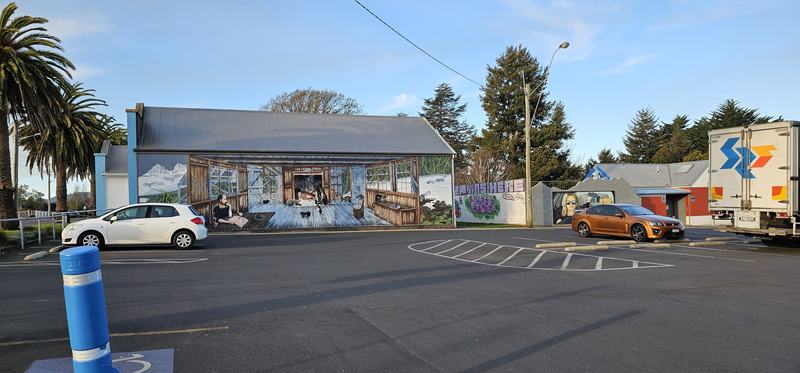
Stillness and Warmth: Weindorfer at Waldheim, the fire lit, the door open, Cradle Mountain in the snow outside.
It paints a line from his diary, and the mural carries the words:
"When the ground is covered in snow, I do build a big fire, open my door, seat myself very, quietly in front of the blazing logs and presently, they come in, one by one, the wild animals, without their usual fear of man or of one another and share with me, the grateful warmth."
So the day ended where it started. His mountain in the afternoon, and then in Sheffield at sunset, him again: by the fire, with the door open, waiting for the animals.
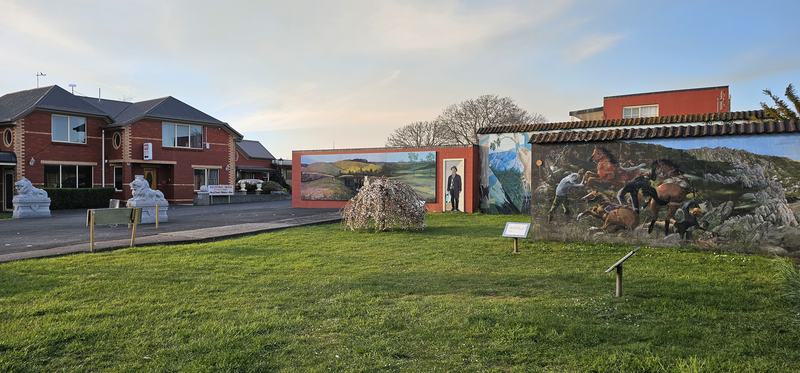
More walls, each with its plaque on a post.
There are now close to a hundred murals. Every November, Mural Fest adds more: selected artists paint in Mural Park, and their work stays up for the following twelve months. Twenty minutes on the main street covers the best of it. It worked, and we are the evidence, stopping here on the way home from somewhere else. We got there at sunset, long after the cafés had shut. The walls don't close.
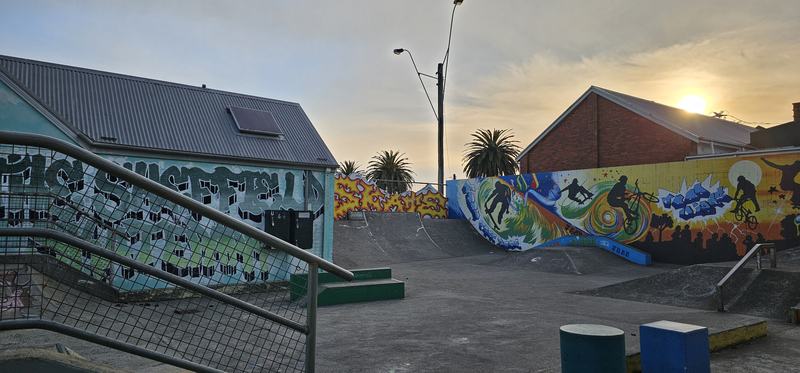
The skate park at sunset. Even the ramps are painted.
Look for
- The shawls in King Solomons: thin, folded curtains of calcite. Photography is allowed, flash included.
- The dip in the skyline between the summit and Little Horn — that's the cradle.
- The black currawongs. Yellow eye, white tail tips. Not ravens, and they'll follow your food. Don't feed them.
- King Billy pine. Waldheim and the boat shed are both built from it; it's the dark, fine-grained timber you'll see around the valley.
- Wombats on the boardwalks in the afternoon. They don't care about you.
- The Ballroom Forest on the lake circuit — a stand of myrtle beech with moss on everything, if you go the full way round.
- Weindorfer's grave, if you visit Waldheim: it's beside the chalet.
- Weindorfer again, in Sheffield: the first mural, by his fire.
The short version
- Morning — Budget on Wellington Street, then King Solomons Cave — 45 minutes underground
- 13:08 — Visitor Centre — a Holiday Pass, two shuttle tickets, one currawong
- Afternoon — Dove Lake — the boat shed, the reflection
- Sunset — Sheffield — Weindorfer again, on the first mural