What the gold paid for
In ten years gold turned Melbourne from a town of 29,000 into a city of 123,000, and the city spent the money on things meant to last. Shirley's last day runs through three of them, a market, a gallery and a tower kept under glass.
When gold was found in Victoria in 1851, Melbourne was a town of about 29,000 people. Then the world arrived. In just four months of 1852, 619 ships came into Hobsons Bay carrying 55,057 passengers. By 1861 the city had 123,061 people.
Most of them came to dig. The city made its money by feeding, housing and selling to them, and then it spent it. By 1861 Elizabeth Ramsay-Laye was describing Melbourne as "a stately city ... lavishing her gold on everything that will beautify and adorn her".
That's the idea for today, Shirley's last day in Australia. Gold paid for a great deal of Melbourne in a hurry, and the parts built to last are still doing their jobs. Today's route runs through three of them: a market, a gallery and a tower.
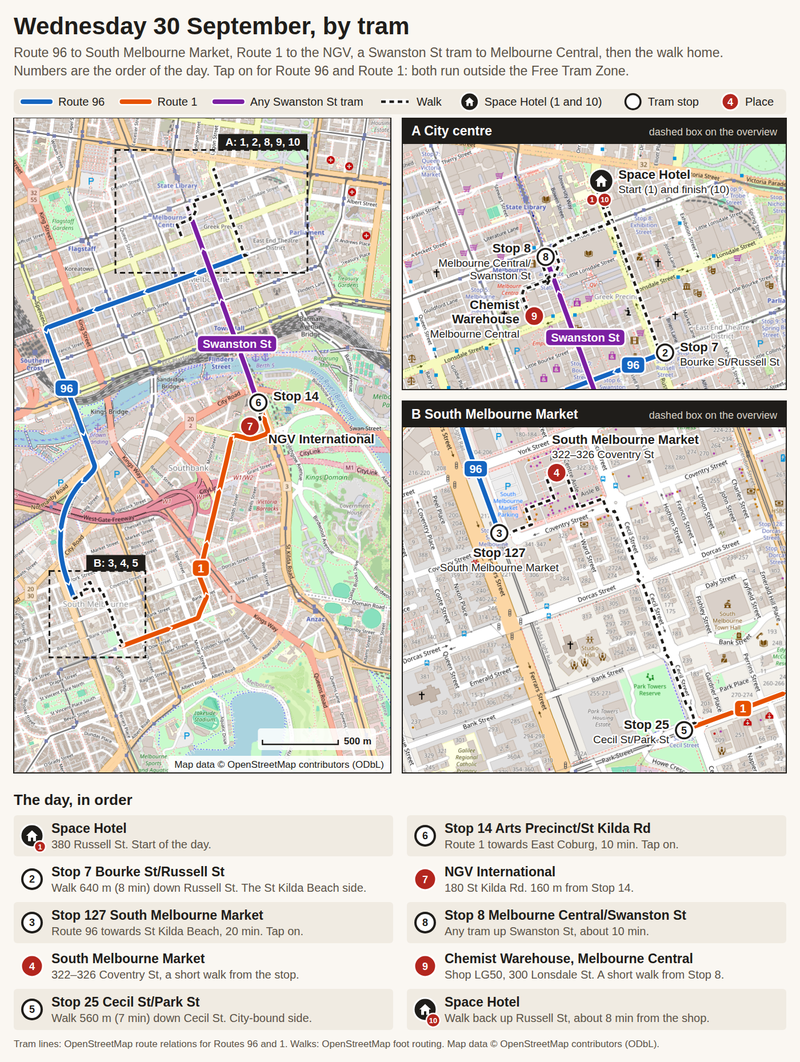
The map
Map data © OpenStreetMap contributors (ODbL).
1. A tram on a railway
The day starts at 7:15 with a walk down Russell Street to the Route 96 tram on Bourke Street. Tap on: the market is outside the Free Tram Zone.
South of the river, watch for the moment the tram leaves the road for a track of its own. That track was the St Kilda railway, opened by the Melbourne and Hobson's Bay Railway Company in May 1857, in the gold decade, and turned into a tram line in 1987. The market grew up beside it: its original ten-acre site ran from Coventry, Cecil and York streets to the railway line.
2. The market the tent town asked for
South Melbourne was called Emerald Hill then, and it started as a camp. The city couldn't house everyone coming off the ships, and several thousand people lived in tents, in "canvas towns". The first, says the Encyclopedia of Melbourne, was on Emerald Hill.
Houses soon went up, and the people in them needed food. In 1856 local householders petitioned the Emerald Hill council for a market. It took until 1867 for South Melbourne Market to open officially, and it has been trading ever since. The market calls itself the oldest continually running market in Melbourne.
In 1981 a fire destroyed the original A and B sheds on Coventry Street. The market carried on anyway. We'll be there when it opens at 8:00, for breakfast: of our three days in Melbourne, today is the only one it's open.
One stall on the corner of Cecil and Coventry streets has its own history. Ken Cheng started selling dim sims from a trolley at Caulfield Racecourse in 1949, then moved to the market. His are round and 100 grams or more, about twice the takeaway size, and his sons took over the business. In Melbourne, SBS says, a big round one is a South Melbourne dim sim.
3. Across the road from Canvas Town
At 9:40, Route 1 takes us from Stop 25 Cecil St/Park St up to St Kilda Road and the arts precinct, ten minutes away.
Just up the road, from 1852, a bigger canvas town grew up near Princes Bridge, on the south side of the river and the western side of St Kilda Road. A Frenchman, Antoine Fauchery, called the canvas towns "a floating city devoured by the sun, inundated by the rain and swept away by the wind". In 1853 a fever epidemic went through. Nothing of it is left.
4. A gallery the colony gave itself
The National Gallery of Victoria says it was founded in 1861, and calls itself the oldest gallery in Australia. It didn't start here, though. It started in the Public Library on Swanston Street, now the State Library. The Encyclopedia of Melbourne describes the library as one of a group of institutions "intended to counteract the upheaval of the gold rush". In 1859 the government granted it £2,000 to buy art.
The gallery shared the library's site for over a century. It moved here in August 1968, into Roy Grounds's new building. An NGV essay describes it as a "bluestone palazzo fortress, with its playful moat and mouse-hole entry". Inside, the Great Hall has a ceiling of coloured glass made by Leonard French between 1963 and 1967. The NGV says it's still the world's largest cut-glass ceiling.
It's also still free. In the NGV's words: "It is a collection that is yours, and it's free!"
5. Gold, again
The one thing we're paying for here is Cartier: $43, timed entry, in its last week (it closes on Sunday 4 October). Nearly 400 jewels and timepieces, with design drawings from the Cartier archives. Louis-François Cartier founded the firm in Paris in 1847, four years before the Victorian gold rush.
After a morning spent in what the gold rush left behind, this is a room full of what gold becomes.
6. Marvellous Melbourne
By the 1880s the gold money had turned into a boom. The British journalist George Augustus Sala visited in 1885 and gave the city the name that stuck: "Marvellous Melbourne". He called it "a really astonishing city", and credited the 1850s gold rush and the "real live men" it brought, who had "made Melbourne what she is, magnificent and marvellous".
The State Library's account of those years has cable trams in it. The first ran in November 1885. By 1891 there were 17 routes and 73 km of double track, the largest cable tram network in the world run by a single company.
Then the boom burst. In 1891 the banks began to collapse, and it took Victoria decades to recover.
7. The tower under the cone
After lunch, any tram up Swanston Street takes us to Melbourne Central, for the trip's last shopping at Chemist Warehouse. Under the glass cone in the middle of the centre stands the building the whole place was designed around.
The Coops came in 1855. Melbourne Central's history says James Coop "was no fool for gold": he had come to sell the colony its plumbing. By the 1880s his son and grandson, both named Walter, were making lead shot. In 1889–90, just before the boom burst, they put up Coop's Shot Tower: 50 metres of red brick, several metres over the city's height limit. Molten lead was poured through a sieve at the top and fell 132 feet (about 40 metres) into water, and by the bottom it had cooled into round shot. By 1894 the tower was making six tonnes a week. The Coops also made the stair grips for Melbourne's trams.
The tower stopped making shot around 1960. It was heritage-listed in the 1970s, so when Melbourne Central went up around it (1986–91), the architect Kisho Kurokawa couldn't knock it down. He put it under a 20-storey glass cone instead, which the centre says was designed to answer the State Library's dome across Swanston Street.
That's the building where the gallery began. So the day ends across the road from where it started, at the library the gold rush built.
8. The fixed point
Then it's six minutes' walk back to the hotel to repack Shirley's bags. She leaves for the airport at 17:30; her flight home to Taiwan is at 21:50.
The idea, again
The tents of Canvas Town are long gone, and a lot of the boom's fortunes went in the crash of the 1890s. What's left is what the gold paid for that was built to stay: a market that's still trading, a gallery that's still free, and a factory tower Melbourne wouldn't give up, so it's kept under glass. Tonight Shirley takes her own small haul home with her. The rest stays here, where the gold put it.
How the day went
Everything above was written the night before. This is what the camera caught on the day. The photos have no time stamps, so they follow the plan's order rather than the clock, and there are none of the Chemist Warehouse stop or the airport run.
We got off Route 96 at Stop 127, South Melbourne Market, where the tram runs on its own track: the old St Kilda railway line. A mural covers the wall behind the platform.
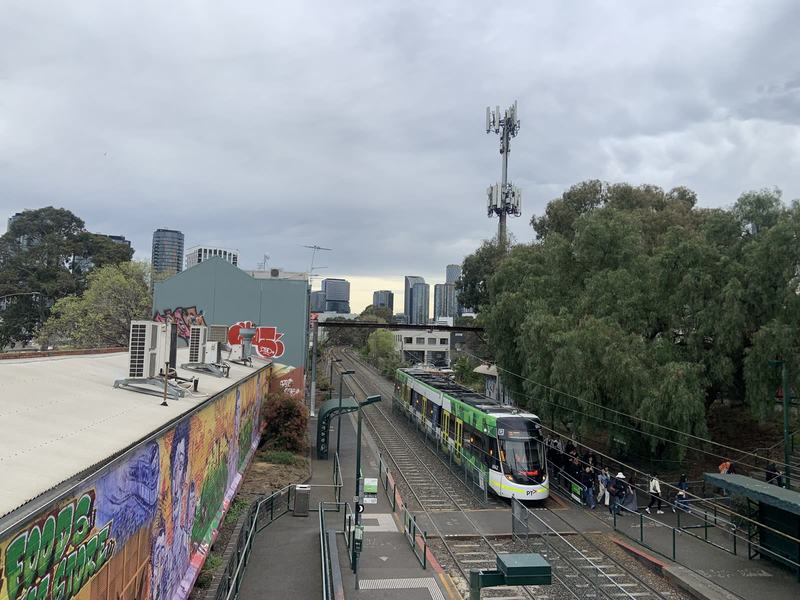
A tram at Stop 127, seen from above the tracks, the city towers behind.
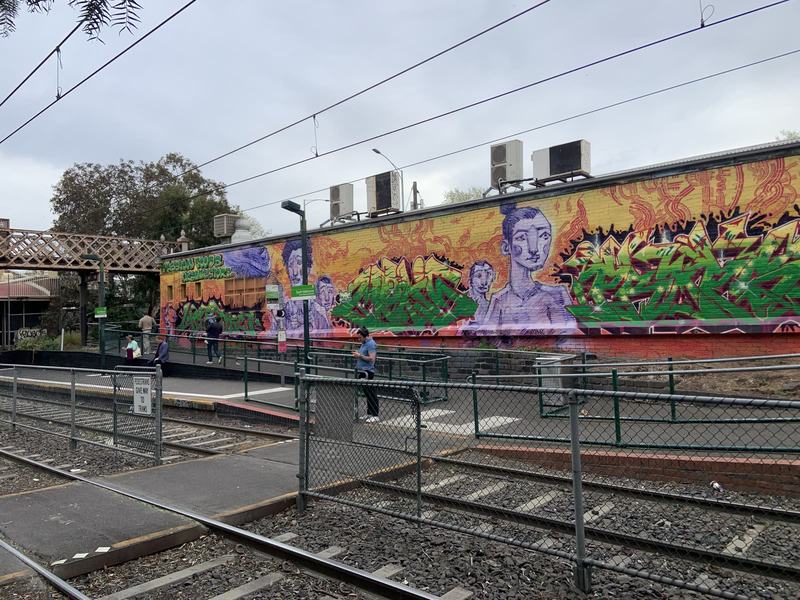
Stop 127 from the platform. The mural behind it carries the words "Passion Foods Organic Store".
From the stop, Coventry Street led to the Food Hall canopy, and inside were the covered aisles of the market that opened in 1867: cakes and sweets, cards and books, linen dresses, lavender at a plant stall, a big geared wall clock, teapots and plates, and a pastry stall with ham and cheese puffs at $8 and dark chocolate cake with a sea salt crumble, $5 for a baby one.
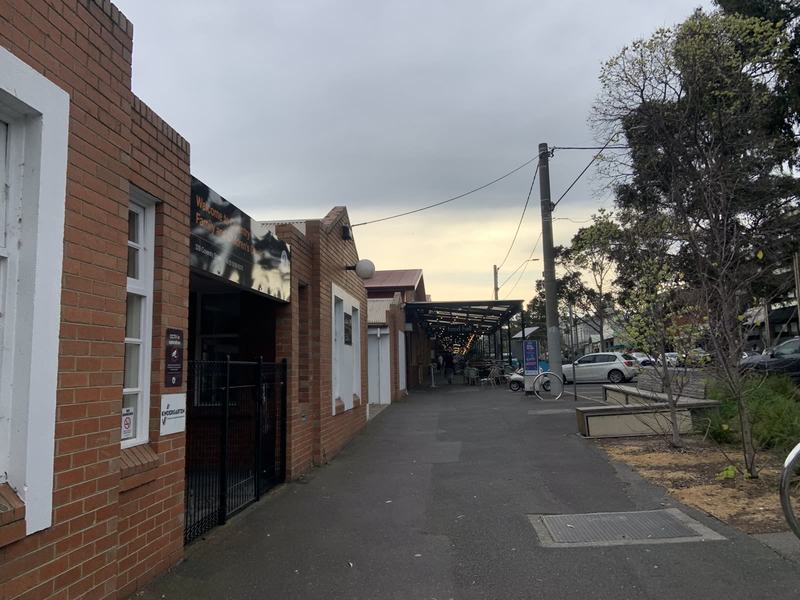
Coventry Street, towards the market's Food Hall.
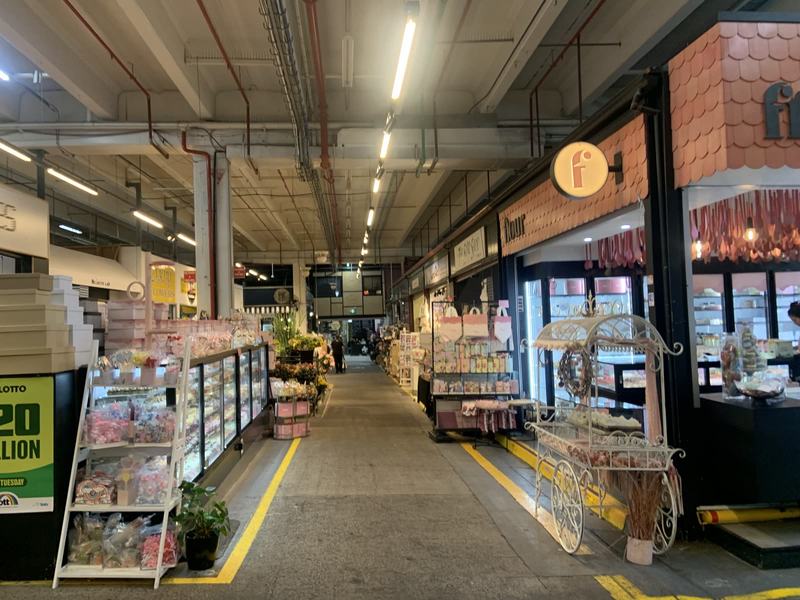
One of the covered aisles: cakes and sweets on the left, a cake shop and gift stalls on the right.
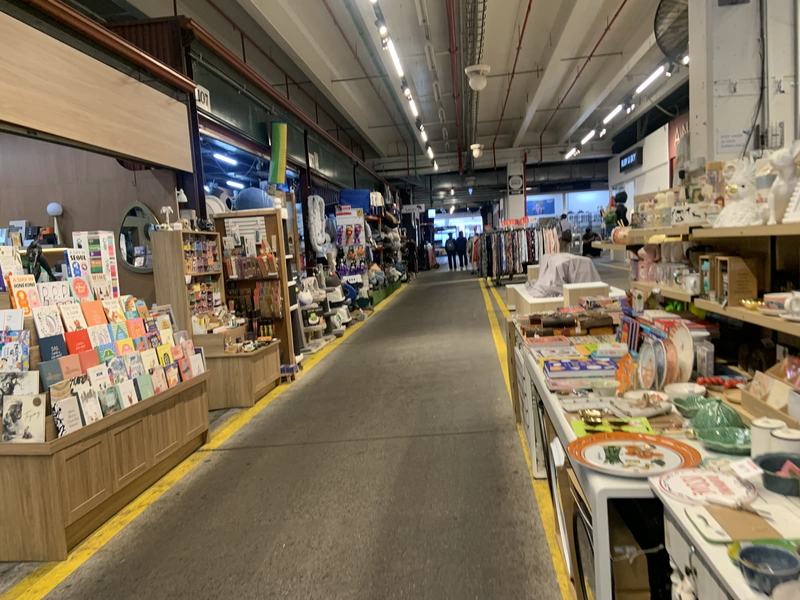
Another aisle, with cards and books on the left and homewares on the right.
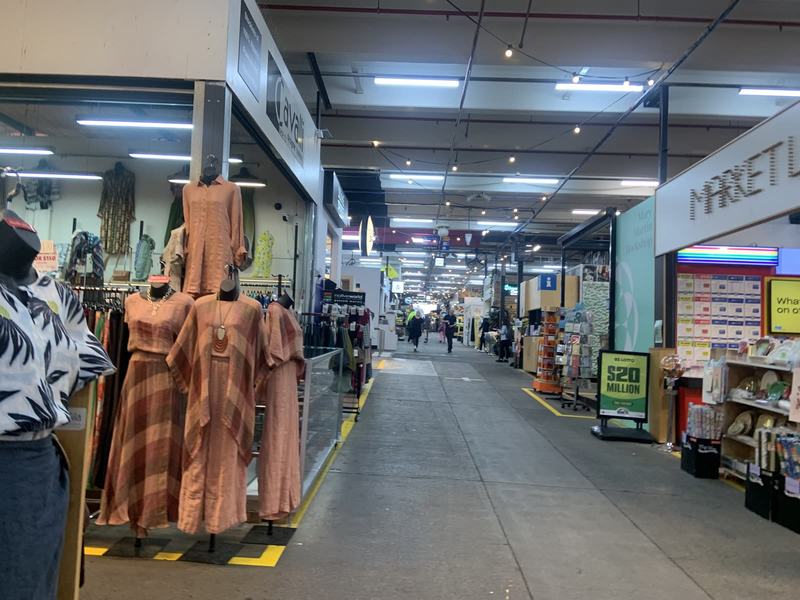
A clothing aisle, linen dresses on mannequins at the left.
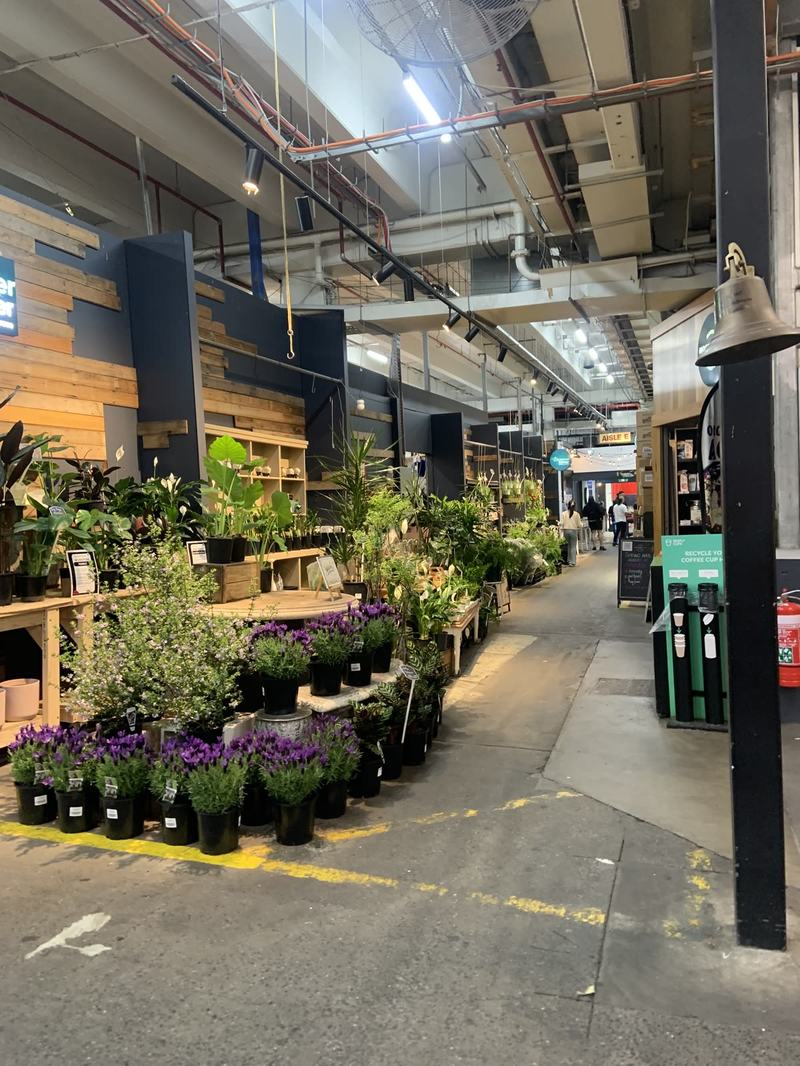
A plant stall with pots of lavender. A brass bell hangs on the post at the right.
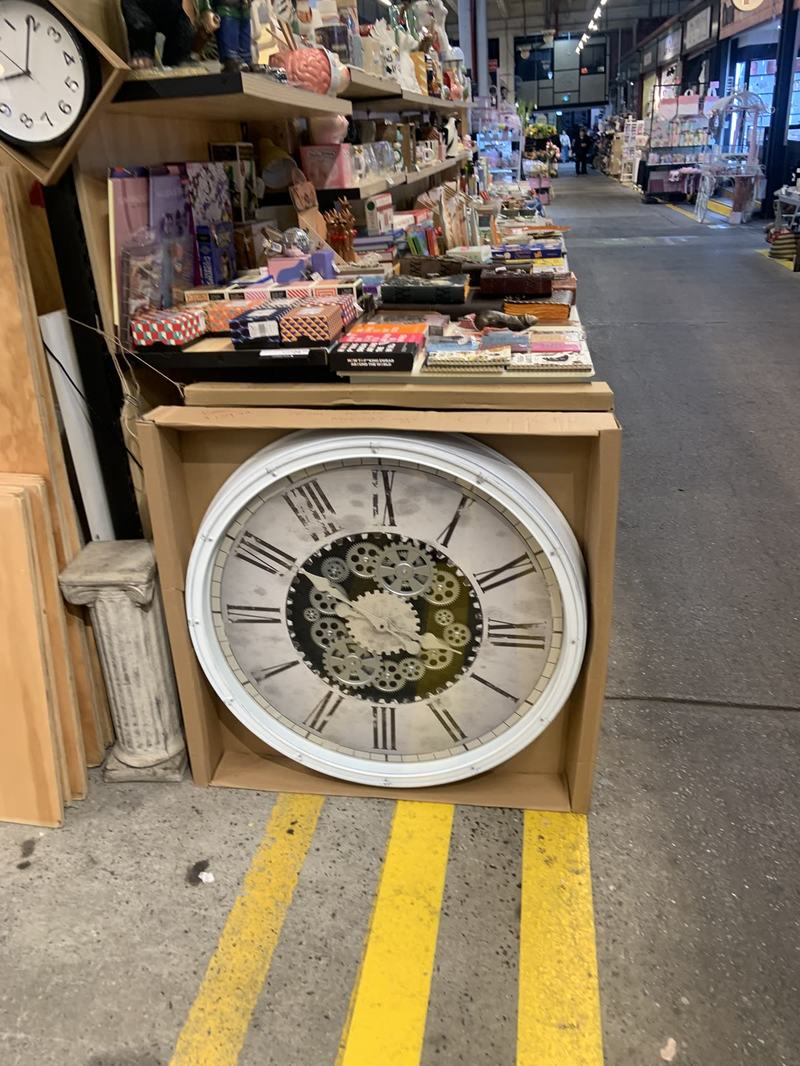
A big wall clock with its gears showing, in a box at a gift and stationery stall.
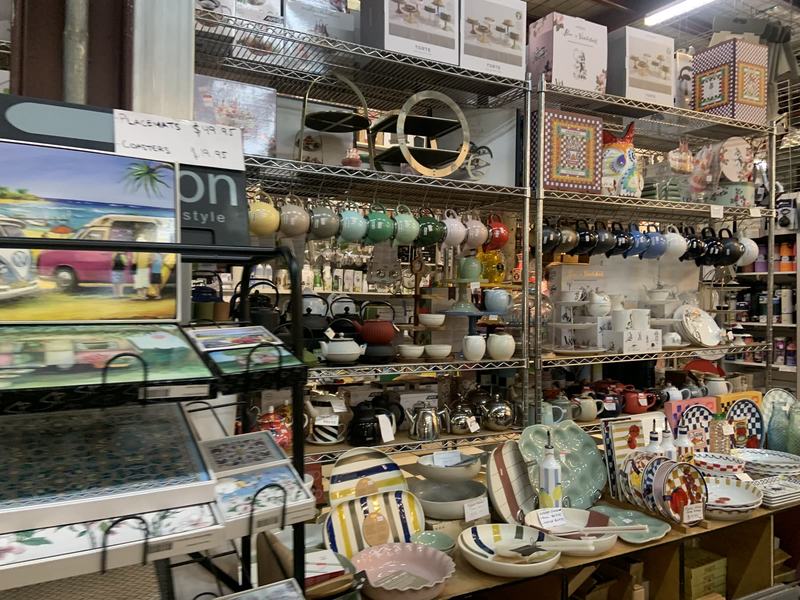
Teapots, mugs and plates at a homewares stall. The sign on the left reads: placemats $49.95, coasters $19.95.
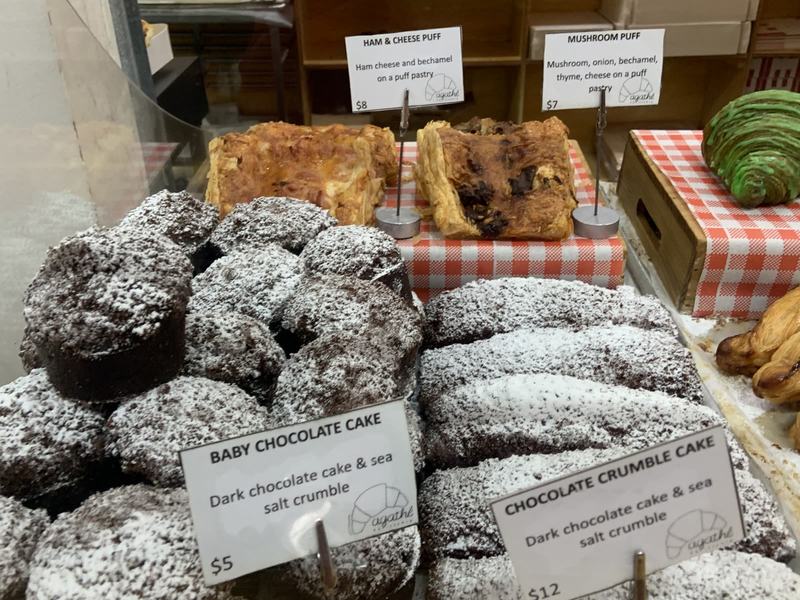
Pastries at a stall whose cards carry the name "agathé": ham and cheese puff $8, mushroom puff $7, baby chocolate cake $5 and chocolate crumble cake $12.
At NGV International the forecourt is held by David Shrigley's Really Good (2016), a seven-metre bronze thumbs-up, and the Cartier banner hung on the wall beside it. The moat ran its fountains along the wall, and in the entrance hall a large yellow sculpture with black dots stood under the Cartier banner on the glass.
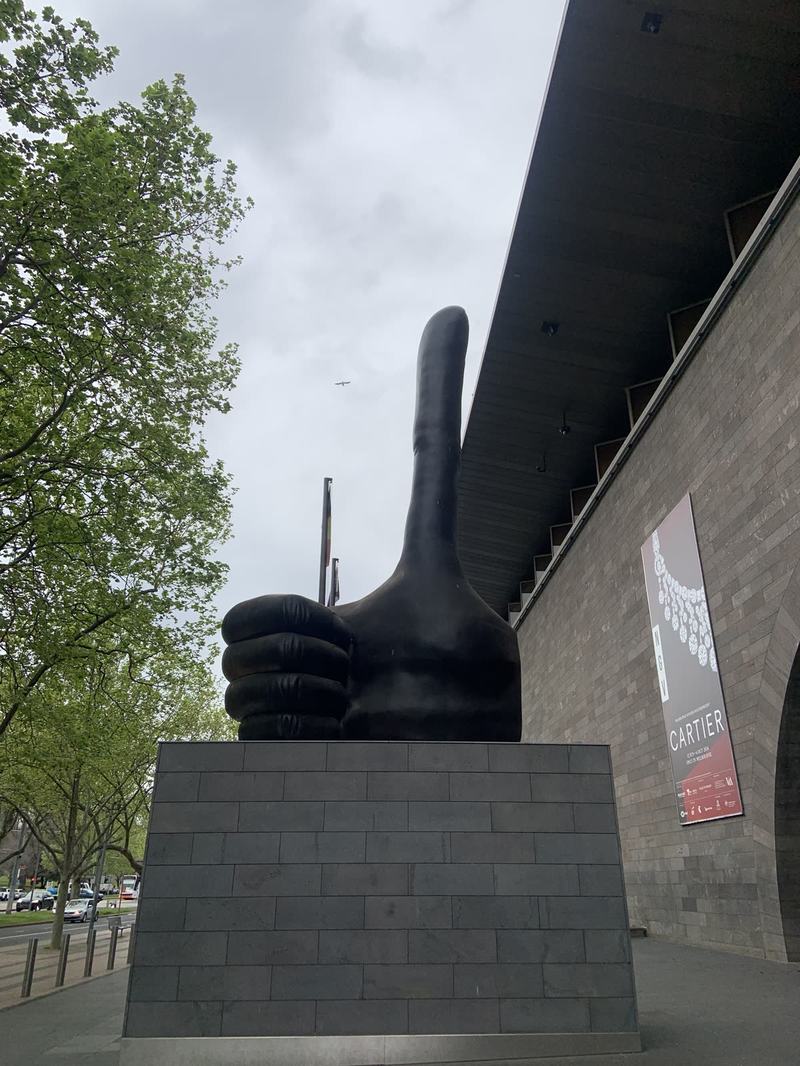
David Shrigley's Really Good (2016) on the NGV International forecourt, with the Cartier banner on the wall beside it.
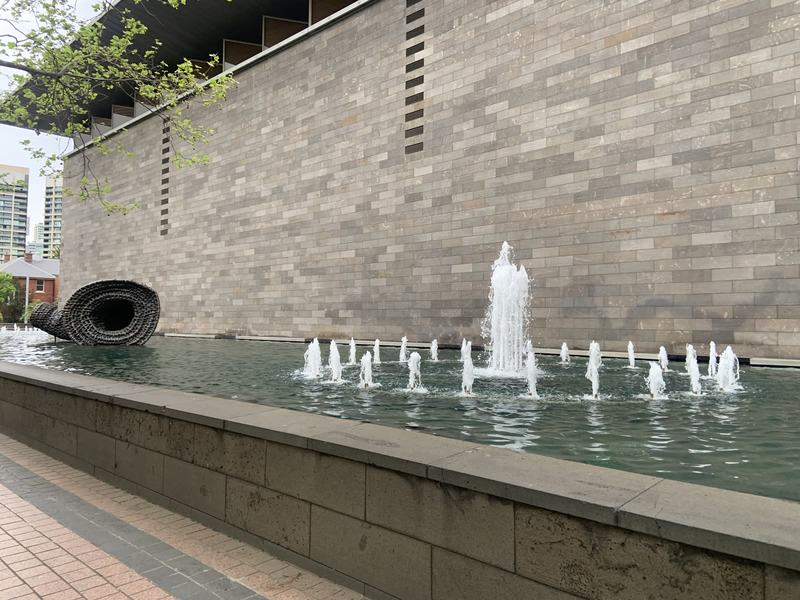
The moat along the NGV's wall, fountains playing.
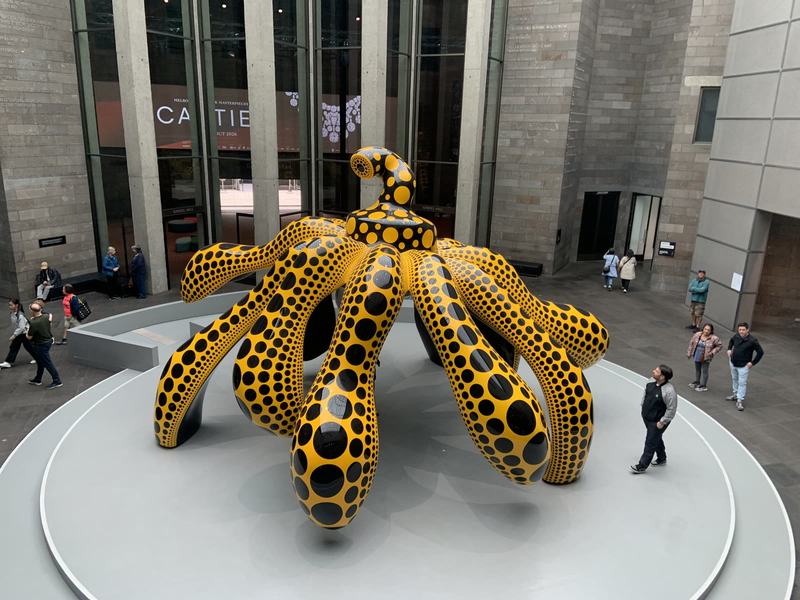
A large yellow sculpture with black dots in the entrance hall, seen from above. The Cartier banner is on the glass behind it, with "Gandel Hall" signs below.
Lunch at Gong De Lin: a tofu dish in an iron pot, green beans, a plate of fried pieces in a brown sauce, and a pot of tea.
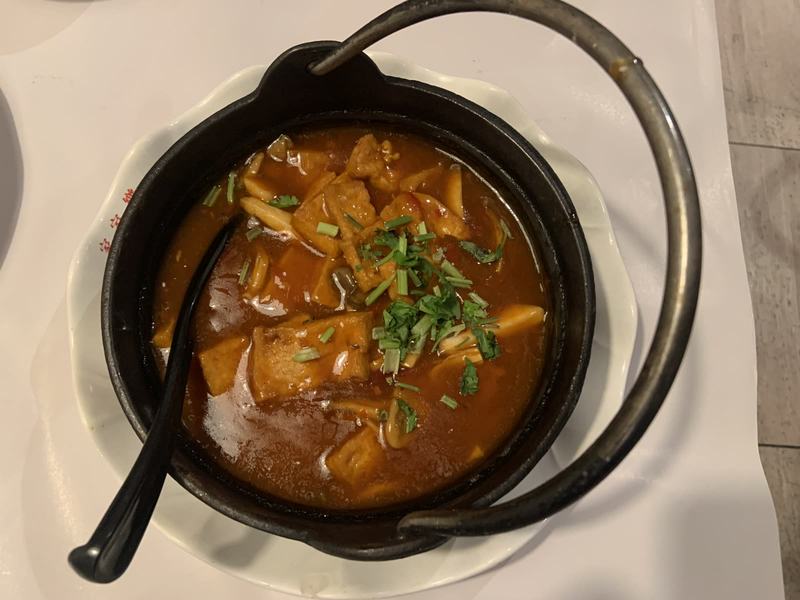
Lunch at Gong De Lin: tofu and mushrooms in a red-brown sauce, in a black iron pot.
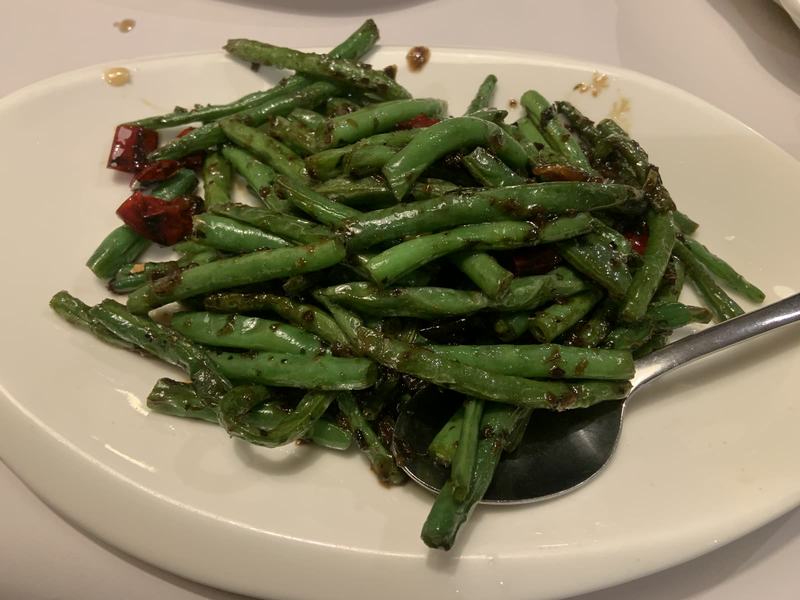
Lunch at Gong De Lin: green beans with dried red chillies.
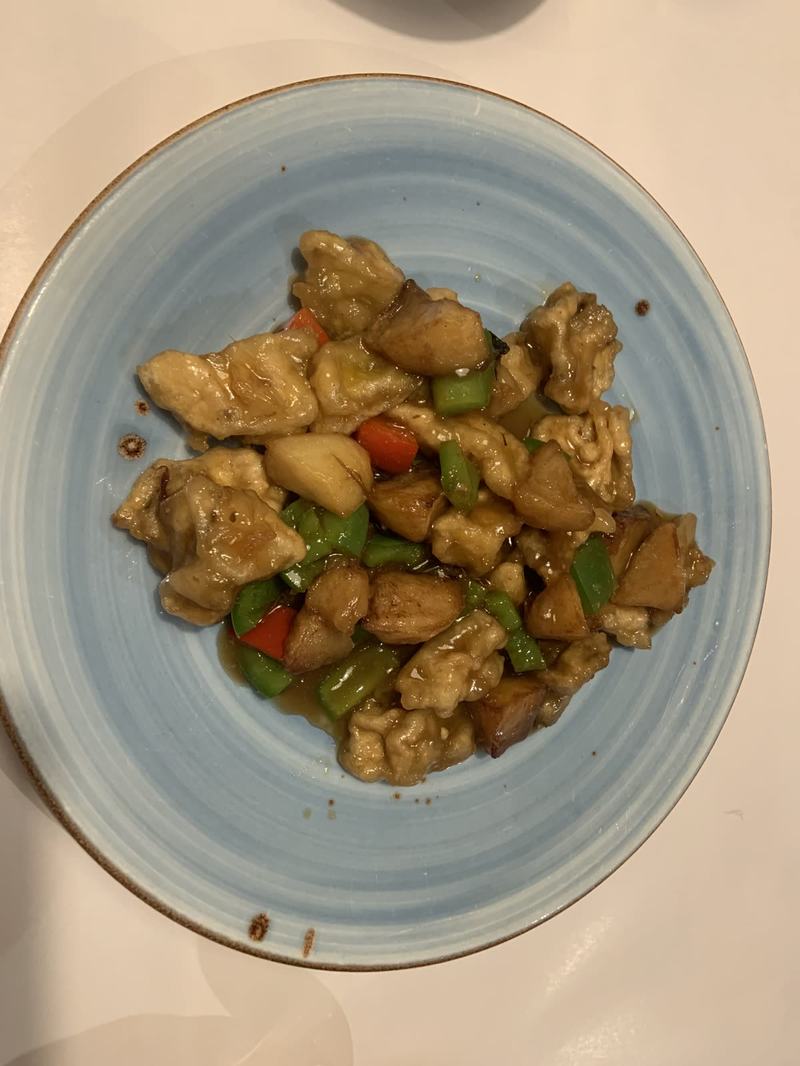
Lunch at Gong De Lin: fried pieces and golden cubes with green and red capsicum, on a blue plate.
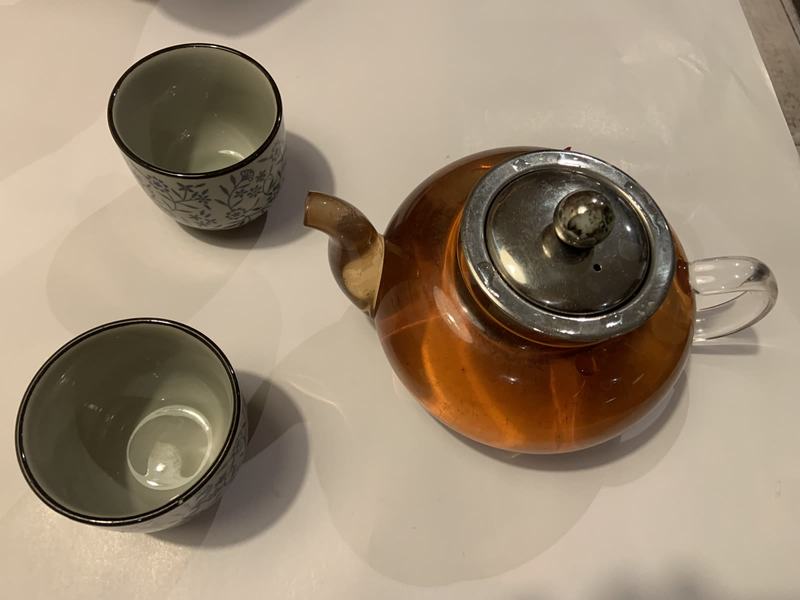
Lunch at Gong De Lin: a glass pot of tea and two small cups.
The camera also found a park pond, with a small island of palms, two dark waterbirds with red bills on the lawn, and the city towers and the Arts Centre's lattice spire over the trees. Roy Grounds, who designed the NGV's building, designed the original spire too; the present one was completed in 1996.
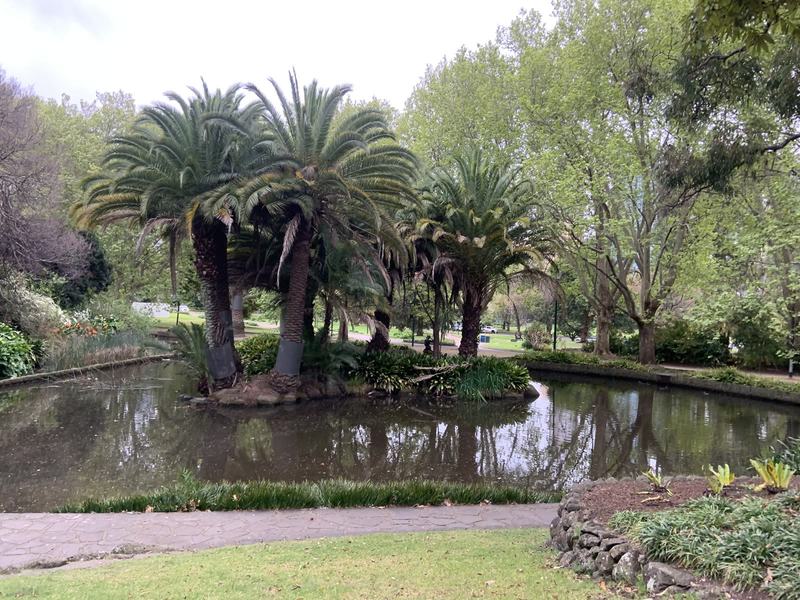
A pond with an island of palms.
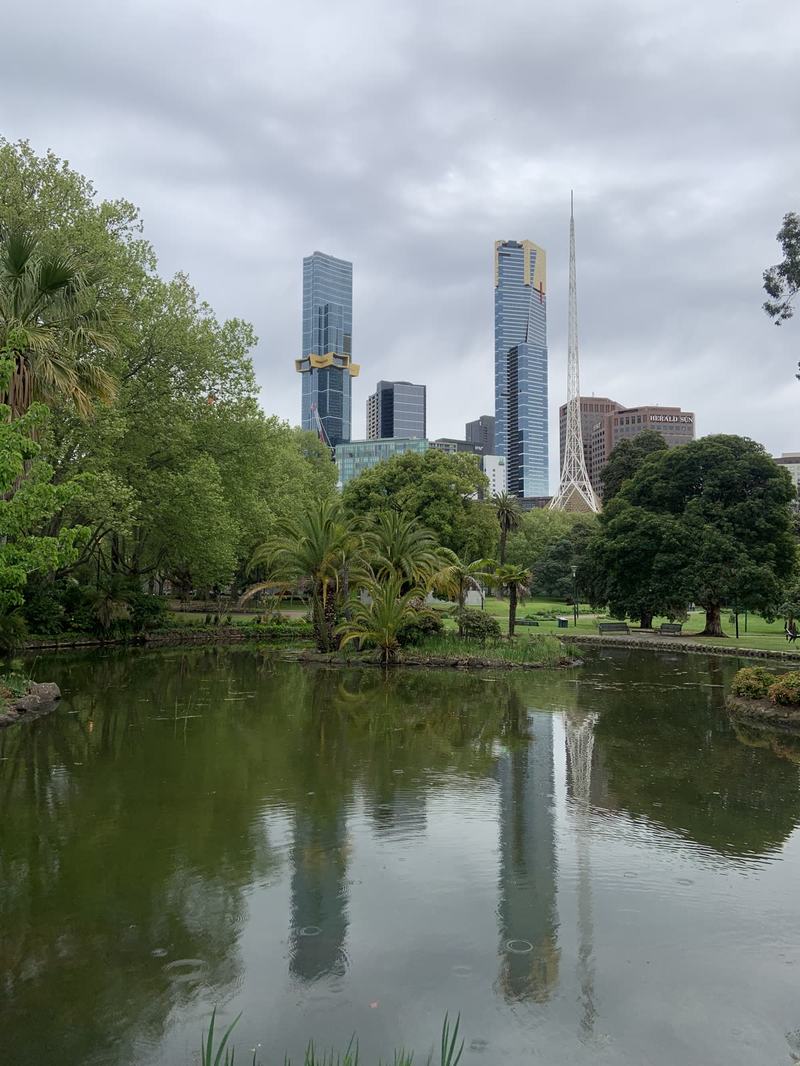
Across the pond: city towers and the Arts Centre's spire.
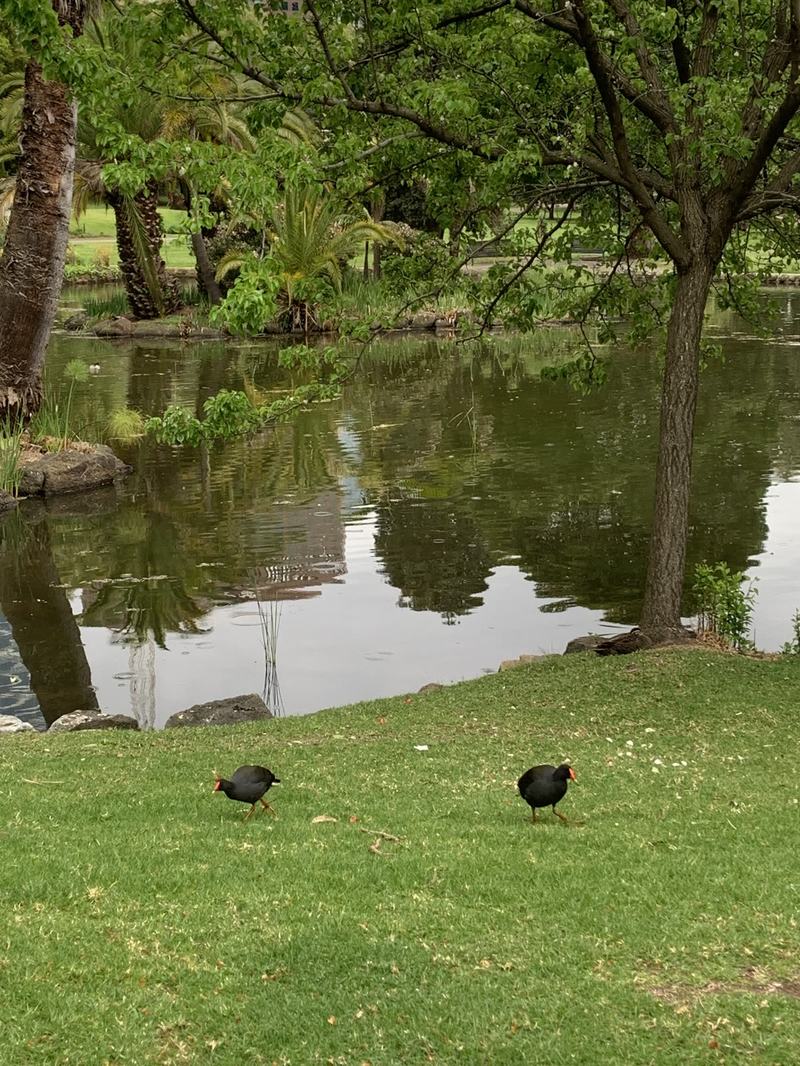
Two dark waterbirds with red bills on the lawn by the pond.
Dinner was at Grill'd in Melbourne Central (no photos).
Look for
- The tram leaving the road on Route 96, south of the river. From there on you're riding the 1857 St Kilda railway.
- South Melbourne Market Dim Sims, on the corner of Cecil and Coventry streets, if it's open when we pass: the round dim sims, since 1949.
- The left-hand side just before the afternoon tram crosses Princes Bridge: west of St Kilda Road, where the bigger canvas town stood.
- The moat and the "mouse-hole" entrance at the NGV, and the Great Hall ceiling.
- In Cartier: the 1902 Scroll tiara, the 1940 'Flamingo' brooch and the 1969 Love bracelet.
- The State Library's dome, across Swanston Street from Melbourne Central. The NGV's first home, until 1968.
- The Shot Tower under the cone. Melbourne Central says its Marionette Watch plays "Waltzing Matilda" every hour.
The short version
- 7:15 — Leave Space Hotel. Route 96 from Stop 7 Bourke St/Russell St (7:25 or 7:33). Tap on
- 8:00 — South Melbourne Market opens. Breakfast
- 9:40 — Route 1 from Stop 25 Cecil St/Park St, city-bound
- 10:00 — NGV International. Cartier is $43; allow 2 hours
- ~13:45 — Chemist Warehouse, Melbourne Central (any tram up Swanston St to Stop 8)
- 17:30 — Shirley leaves the hotel for the airport, Terminal 2. Flight 21:50
More places nearby: Melbourne anytime.
Sources: eMelbourne, the Encyclopedia of Melbourne, University of Melbourne (Gold; South Melbourne; National Gallery of Victoria; State Library of Victoria; Marvellous Melbourne); South Melbourne Market (history; South Melbourne Market Dim Sims); SBS Food ("Six decades of South Melbourne Market Dim Sims"); Wikipedia (St Kilda railway line; Arts Centre Melbourne); NGV (About; NGV International: 50th Anniversary; "Encountering art in the people's gallery"; Cartier; David Shrigley, Really Good); State Library Victoria (Marvellous Melbourne; "Victoria through the ages: the boom years"); Victorian Heritage Database (Coop's Shot Tower and flanking building); Melbourne Central (our heritage). Times from the day note (PTV timetable data).